WHEN NORMAL FEELS ABNORMAL🌞: SELECTED INSIGHTS FROM JLF 2025

EACH YEAR, AS THE LITERATTI, POLITICOS, AND STORY TELLERS DESCEND ON THE JAIPUR LITERATURE FESTIVAL STAGES, WE ARE REGALED BY THE VOICES OF HIGHLY EVOLVED PERSONALITIES. SANGEETA WADDHWANI CULLS SOME PRICELESS INSIGHTS FROM SELECT SESSIONS, ALL THE WHILE WONDERING WHERE DID THOSE TEMPESTOUS, CONTROVERSIAL, PROVOCATIVE AUTHORS GO?

First things first.

Kudos to JLF for soldiering on, rooting for the power of fresh ideas, looking up and bringing in fresh voices and audiences for books – a 1,500 -year -old medium that tends to be consumed more now as material for podcasts, micro-blogging, OTT webseries. Or of course, as an Audibles on Amazon experience!

As a book loving purist, each year, I attend JLF telling myself, “no need to bring heavy books home…just download the kindle version or Audible and listen to it as a bedtime ritual:)”

But nothing beats the high of holding a fragrant, hot-of-the-press hard copy and even better, meeting the author and getting it anointed by a signature. Old habits, thankfully, die hard!

My first session at JLF featured Tina Brown speaking to Chiki Sarkar. Titled after Tina’s new book, The Palace Papers: The House of Windsor,  it was all about watching the former Editor- in -Chief of Vanity Fair and the Tattler, and now the Daily Beast, an online venture, share perspectives on the beleagured institution of the British monarchy, seeing how it will eternally be one of the most engaging “reality shows” of all time!

In a rivetting analysis of the House of Windsor, Tina Brown shared why Kate Middleton is an apt future queen. “I think Kate is more decided and focused on being queen, than William is towards being a King!” 

She had an interesting view of Meghan surrendering her royal status as very naive….”She thought she is already an established celebrity, with or without royal status. But they have lost ground trying to monetise their former status. Now they are only approached by small charities and low profile organisations.”

She also thinks the British public will never take Harry back unless he divorces Meghan…”They will certainly not take Meghan back.”

She also feels Netflix’s The Crown “did humanise the royal family. The public needed to see them as real people with real issues, beyond the paparazzi approach.”

She also admits that “there are and always will be new plotlines in this royal reality show…it’s going to be eternally interesting!”

Chiki Sarkar @chikisarkar, publisher, did ask some truly pointed questions like why all this global interest in British royalty in a post-monarchic world?  Tina felt it was the sheer gorgeousness of Princess Di that catapulted global attention to the British monarchy…”there are many dysfunctional royal families..say like the Dutch royal family…but they’re boring!” she laughed.

“The women do much better at sovereignty,” feels Tina..right from Queen Victoria to Queen Elizabeth, to possibly Kate Middleton next. Kate unlike Diana, has very close ties to her mother (a quintessential Mrs Bennet from Sense and Sensibility!) And very close ties to her sister. The Middletons have never leaked any stories to the media in all these years. That itself is pretty extraordinary!”

Tina stated that it took William 10 years to propose to Kate because he was worried about Kate being suited to tolerate the protocol and lack of privacy his mom could not tolerate. But Kate proved that she did have what it took, over their 10 year courtship.”

Of course Tina’s latest book sold out post session, but being a former Executive Editor at HELLO! (a brand obsessed with royal families)… am going to order a copy online!

With Tina Brown in the early years of JLF

Another session, BIOGRAPHER’S ART, featuring Tina Brown, Robert Service, Benjamin Moser, Janaki Bhakle, Narayani Basu, in conversation with Anita Anand, had beautiful insights being shared on the art of writing an authentic biography.

Clearly tapping into genuine insider information, for a rich portrait, was the most important aspect of such an effort. In this session, Tina shared that a former royal aide who had been dismissed once the royal purse strings were drawn tighter, was her biggest ally in revealing the lesser known side of the British royal family. “But I could not endanger his life by using his narratives…he agreed to talk because we had agreed it was off the record!”

What did she posit as a solution? “This may sound terrible, but sometimes it helps if your source exits the planet…my source died six months before my book was published!” she shared, confirming what I have long suspected about the magic of storytelling. If you are trying to share the truth, it will always find its way into the world!

THE ECONOMICS OF ART: POLICY, INNOVATION AND INCLUSION, was another fascinating session moderated by festival producer Sanjoy Roy, featuring  Chief Executive, British Council, Scott McDonald, Director of the Museum of Fine Arts, Houston,  Gary Tinterow and CEO of the Metropolitan Museum of Art, Max Hollein.

Scott McDonald, Chief Executive of the British Council, India, revealed that the British government had actually mapped how much the arts earned for the economy. Think of how much we pay for concert tickets these days (remember Coldplay ticket sales in India?)

According to UNESCO, the creative economy, which employs 48 million people and currently contributes 3.1% to global GDP, is expected to account for 10% of the global GDP by 2030.

Keeping this in mind, Sanjoy asked, “What are we doing to the creative economy, especially in populous nations like India?”

In an earlier panel on the same topic in Mumbai, with Avid Learning, he had shared a fascinating initiative by Jio (Reliance) on putting special scan codes on handloom woven sarees from Varanasi, (often priced at over a lakh), to ensure the customer that what she was buying into was genuinely bespoke, not factory made.

“It was very easy to duplicate the look and feel of such sarees and take business away from the weavers,” he shared. “These communities have their skills embedded in their muscle memory across generations…they need to be protected!”

Gary Tinterow, said something very lyrical about what museums achieve…”In museums we see different cultures and their arts, telling us stories in a non-confrontational dialogue. The arts bring people into unity; while politics and economics often keep nations apart.”
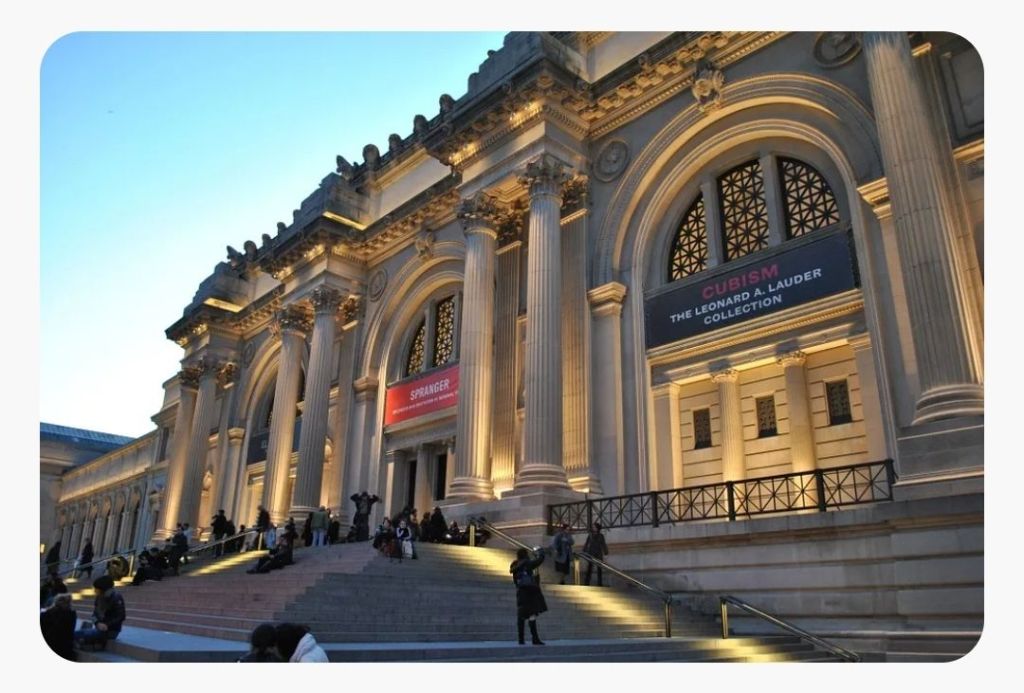
The MET. Museum: 2 million square feet containing 300,000 years of art history

Chief Executive, British Council, Scott McDonald, explained how Great Britain “has mapped the creative economy, so today banks and investors offer support to artistes, performing artistes, and arts related ventures – from festivals to funding movies – knowing what their ballpark earnings can be!

The message was loud and clear to all nations rich in arts history, heritage, and a thriving gig economy…map your creative economy!

A session with a rather bombastic title SUPERWOMEN & SUPERPOWERS: REFRAMING FICTION, featured the voices of  Huma Qureshi and Bee Rowlatt, chaired by Anish Gawande.
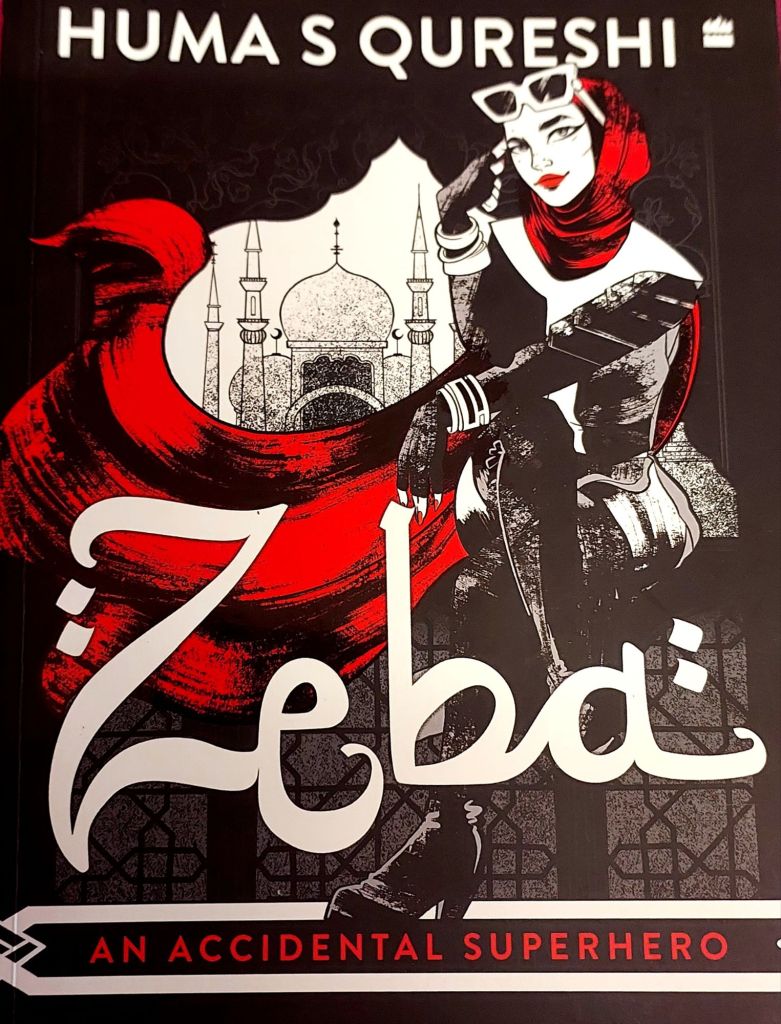
Huma Qureshi’s latest book

I immediately bought Huma Qureshi’s book, intrigued by the fairytale storytelling style, and the backcover assuring me that one has met many such ‘heroines’!

Her protagonist is described as “Spoilt, rich and interested in nothing except lazing on the terrace of her plush New York apartment and inhaling deep drags of her favourite weed…”

While  Rowlatt spoke about One Woman Crime Wave,  Qureshi shared insights into Zeba: An Accidental Superhero. Both authors discussed themes of liberation, class, and social inequality, with Rowlatt highlighting the absence of these themes in British literature. Here is a video excerpt:

INDIAN GENIUS: THE METEORIC RISE OF INDIANS IN AMERICA

Author Meenakshi Ahamed opens the session on her book

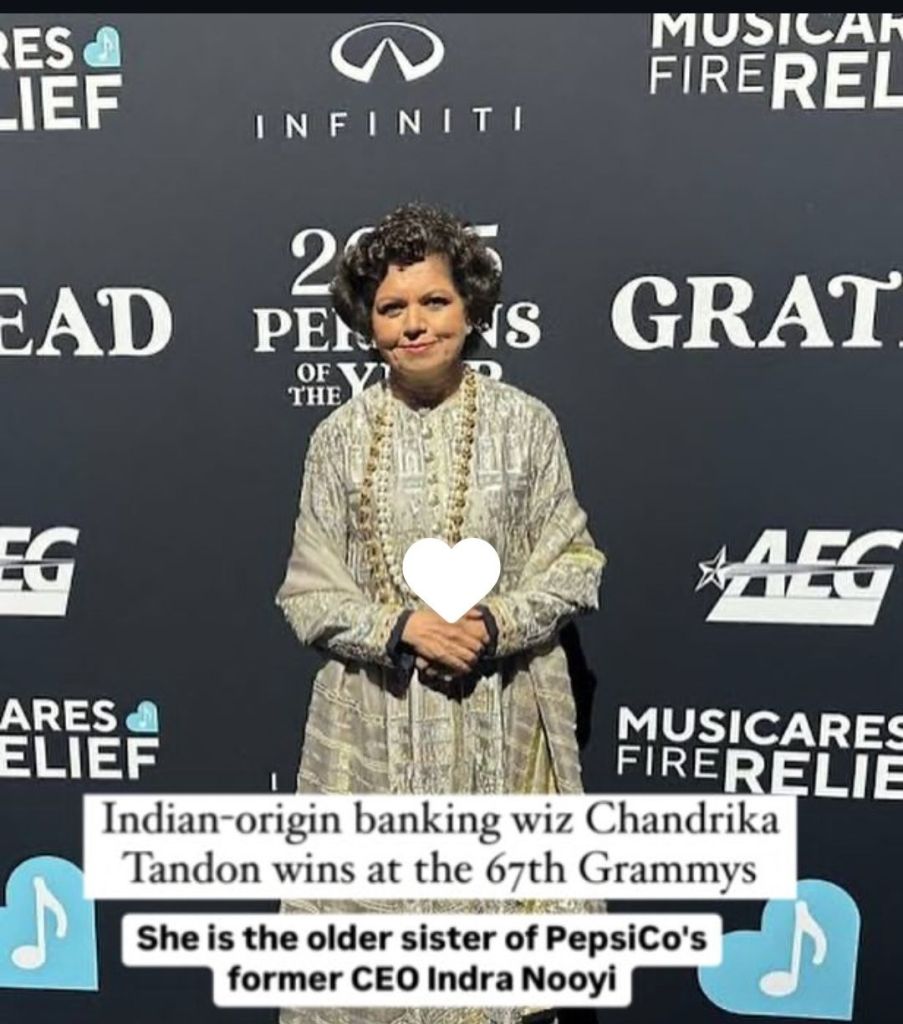
A long overdue book, (given all the viral videos praising Indian American super- achievers), author Meenakshi Ahamed had us enthralled from the word go, opening her discussion with the morning’s BREAKING NEWS, that former PepsiCo CEO’s older sister Chandrika Tandon, had picked up a Gramny award for her unique fusion music. Meenakshi felt that Chandrika had a far more interesting journey as despite phenomenal success as a banking professional, she quit while ahead and started her own consultancy, which also did exceedingly well.   With all that dosh..what next? She went back to revisiting her passion for Carnatic music, attempting fusion blends, making albums, going viral, and finally getting a Grammy!

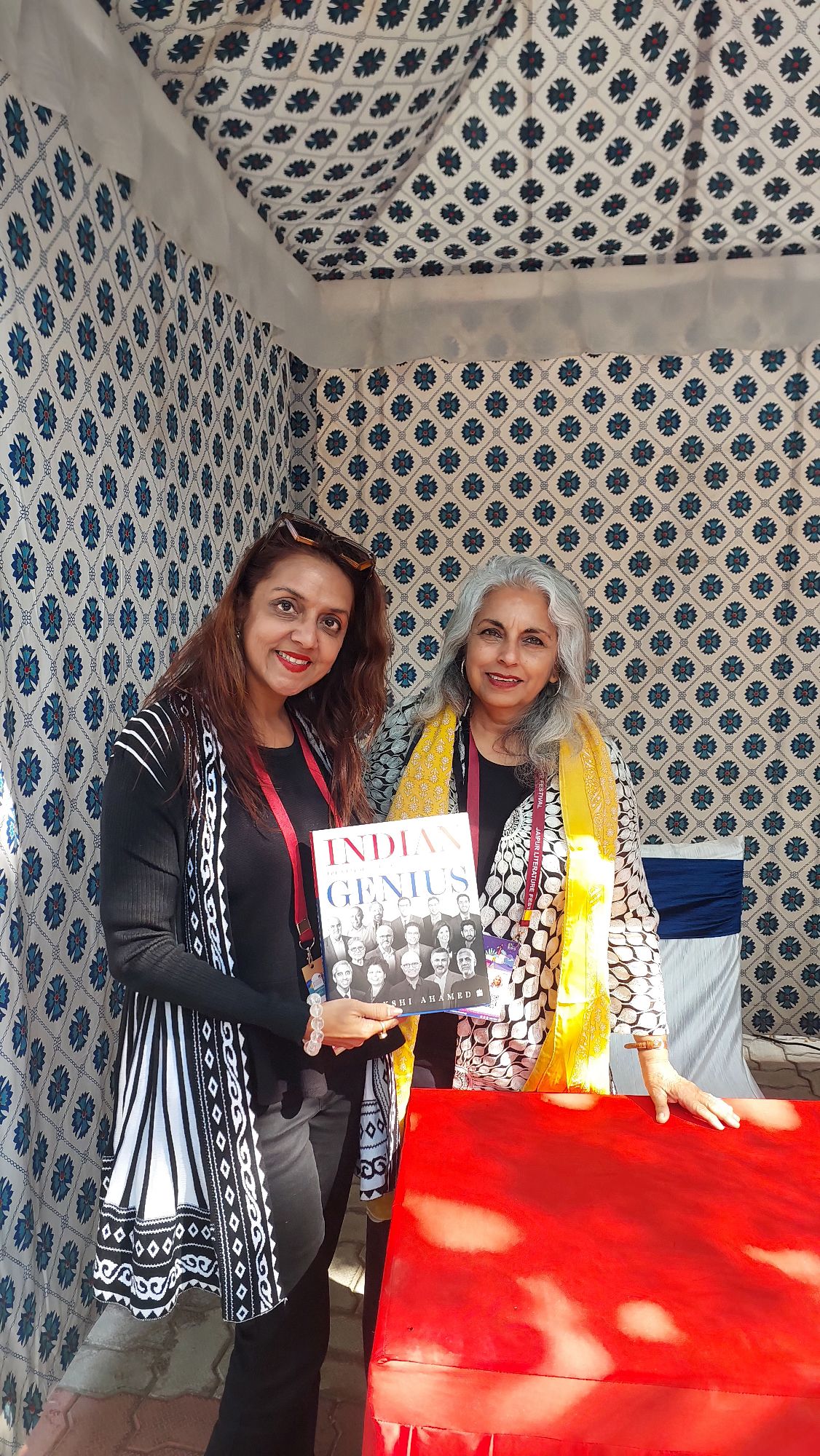
In this session, like many others, Meenakshi expressed a little skepticism about the veracity of Dr Deepak Chopra’s phenomenal scale of influence. It was only as she got talking to real people (not just the Beverly Hills glitterati) about how he had supported them in tough times, and how he was an excellent endocrinologist with his patients…AND she discovered his body of work spanned 90 books…that she went on to include him in ber opus!

At the author signing, I shared my experience interviewing Dr Chopra when at ELLE magazine. I also read out the introduction I had presented in the article, which she almost clapped her hands for:) I told her Dr Chopra was in India addressing live questions from young seekers on a chat online. Post session, he told me, “I get far more intelligent questions in India than America!”

The opening of Meenakshi Ahamed’s session

UNDER THE WEATHER: A CLIMATE AND DISEASE DILEMMA

This session, featured the voices of Pranay Lal, Jay Lemery,  James Bradley, the highly articulate and passionate Varshica Kant, all in conversation with Swati Chopra.

Given we had an English summer going on in the midst of a Jaipur winter, this was  a topic close to my heart. It  presented some truly surprising new ways of looking at the climate crisis.

Pranay Lal, a passionate environmentalist, and author of  Indica: A Deep Natural History of the subcontinent, shattered the idea that planting more trees can help balance our carbon footprint. “The ocean and our rivers and lakes have a far greater capacity to do that,” he shared, elaborating on how that works. But what caught my attention, was the marriage of myth and science, when he touched upon the self-purifying properties of the dancing Ganga river.
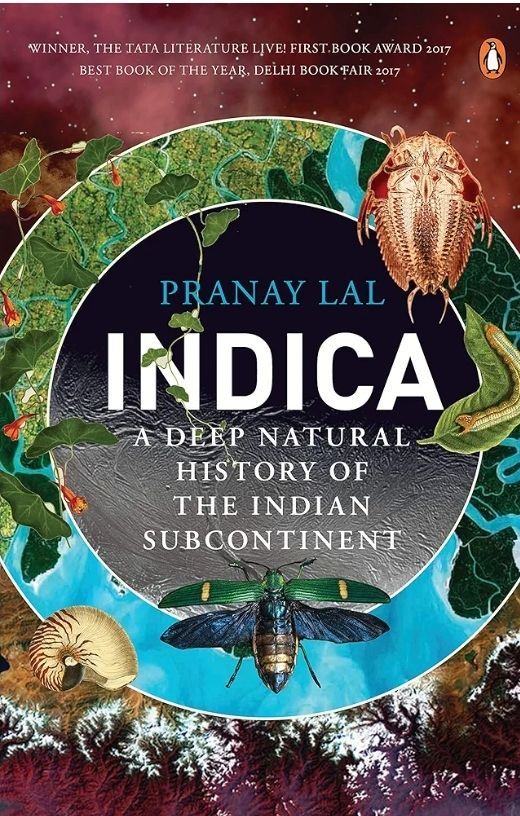
“The unique property of the Ganga River that allows it to somewhat absorb pollution is its high concentration of bacteriophages, which are viruses that naturally kill bacteria, giving the river a certain level of self-purifying ability compared to other rivers,” we read on a google search.

However, in a follow up chat with Pranay Lal, we are told, “When the monsoon hits the young silicate rocks around the Himalayas, there is a degree of silicate erosion. This silicate in the water, binds with CO2, or carbon dioxide, in the water and air.

“Rain, as it falls, in the first few days and even later, is as acidic as a carbonated beverage.  Eventually, with silicate compounds, all the C02 in the water is captured. Silicates are also a deterrent for bacteria. Hence, Ganga water never spoils.”

Yes this may have spiritual significance for our people, but there is also a geological explanation.  However, research also says  “This property is not strong enough to counteract the significant pollution levels the Ganga faces due to human activities along its banks. “

One can imagine how, for centuries, Kings and even foreign emissaries travelled only with Ganga Jal as it was fresh and drinkable even months after being stored. Remember those epic silver water vessels in City Palace, Jaipur?

Many other observations were shared by other panelists. Sharing a video excerpt above.

IMTIAZ ALI A JAMSHEDPUR BOY TURNED BOLLYWOOD POTBOILER SPINNER

The man we rarely see live in front of audiences, had a surprisingly electrifying rapport with the movie-loving audience on the last day of the festival.

Imtiaz Ali spoke in rich metaphors about artistes seeking to not just have box office validation, but a validation from the artiste they see in the mirror.

So a stubborn fan asked him, at which point in his career did Imtiaz feel validated by his own reflection? Imtiaz narrated a moment when, in a small town, a beard shaving stall in a tiny bylane, had pasted his poster on a wall!

The fan felt, “But sir, is that not external validation?”

“Well in the creative arts, the external and the internal are not exclusive!” he smiled.

Imtiaz Ali had the air of a slightly rakish, handsome, untameable and poetic film-maker…associated with iconic popular cinematic capers like Jab We Met, Rockstar, Love Aaj Kal, Tamasha, When Harry Met Sejal  (could we be more subtle in making a Hollywood knock off😂) and we heard lots of women asking about Chamkila, and my favourite, Highway. 

Alia Bhatt’s brilliant performance in Highway (a film I literally watched in my Times of India office before interviewing Alia for a cover story), as a girl who has been sexually abused in her extended family, who is then kidnapped and starts feeling a sense of affection for her kidnapper (Stockholm syndrome). Well, here was the film-maker, the vision behind some of thd most powerful performances. Rockstar was virtually a cult film with the young, and even I had recently seen what mastery Ranbir Kapoor shows as pain enters his life and brings depth to his musical journey.

Films may be now competing for eyeballs with OTT platforms and the comfort of entertainment at your fingertips, on your lazy looking couch….but in Jaipur, the fans emitted an oceanic energy …as if these narratives were part of their inner, not outer worlds!

Do see the video embedded here…

Many were the insights gleaned from the many sessions, and I found myself risking excess luggage (and setting myself up for late nights and early mornings) devouring the books I bought.

Some books caught my eye even without any session to correlate them with…like this one below, with the brilliant and timely title, Genome to Om…tracing how empirical, sense driven paradigms of scientific data were moving into more metaphysical zones..
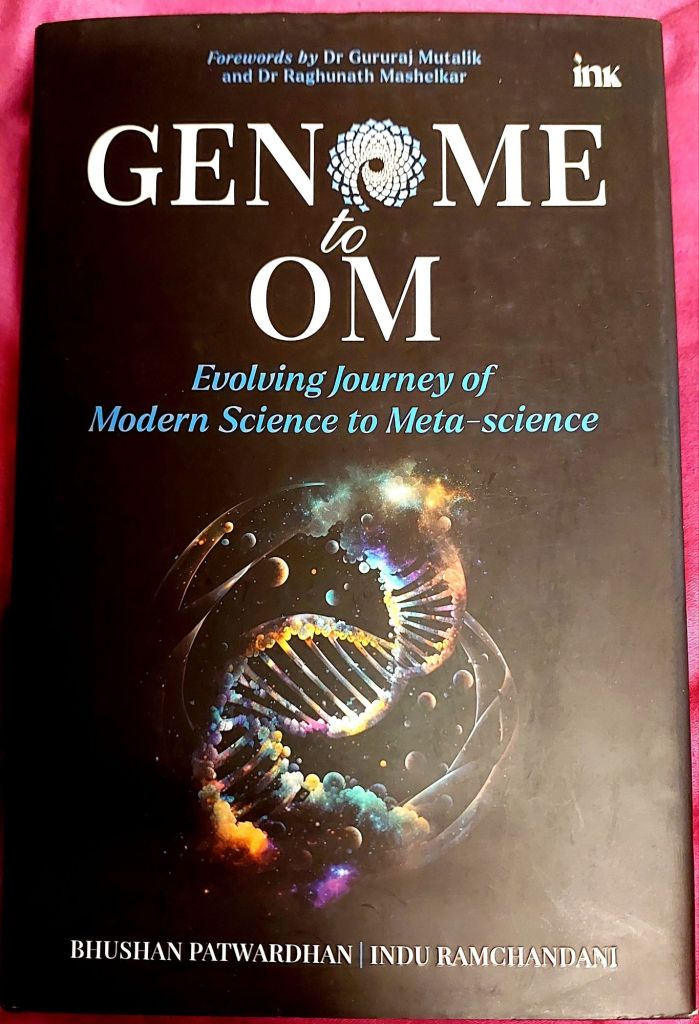
If one had to sum up this year’s JLF experience, I would say there were some memorable moments. But the evenings felt bereft of our usual menagerie of Mumbai-Delhi lit fest perennials. Except, of course my friend Nawaz Singhania was there to read from her book, Pause, Rewind!

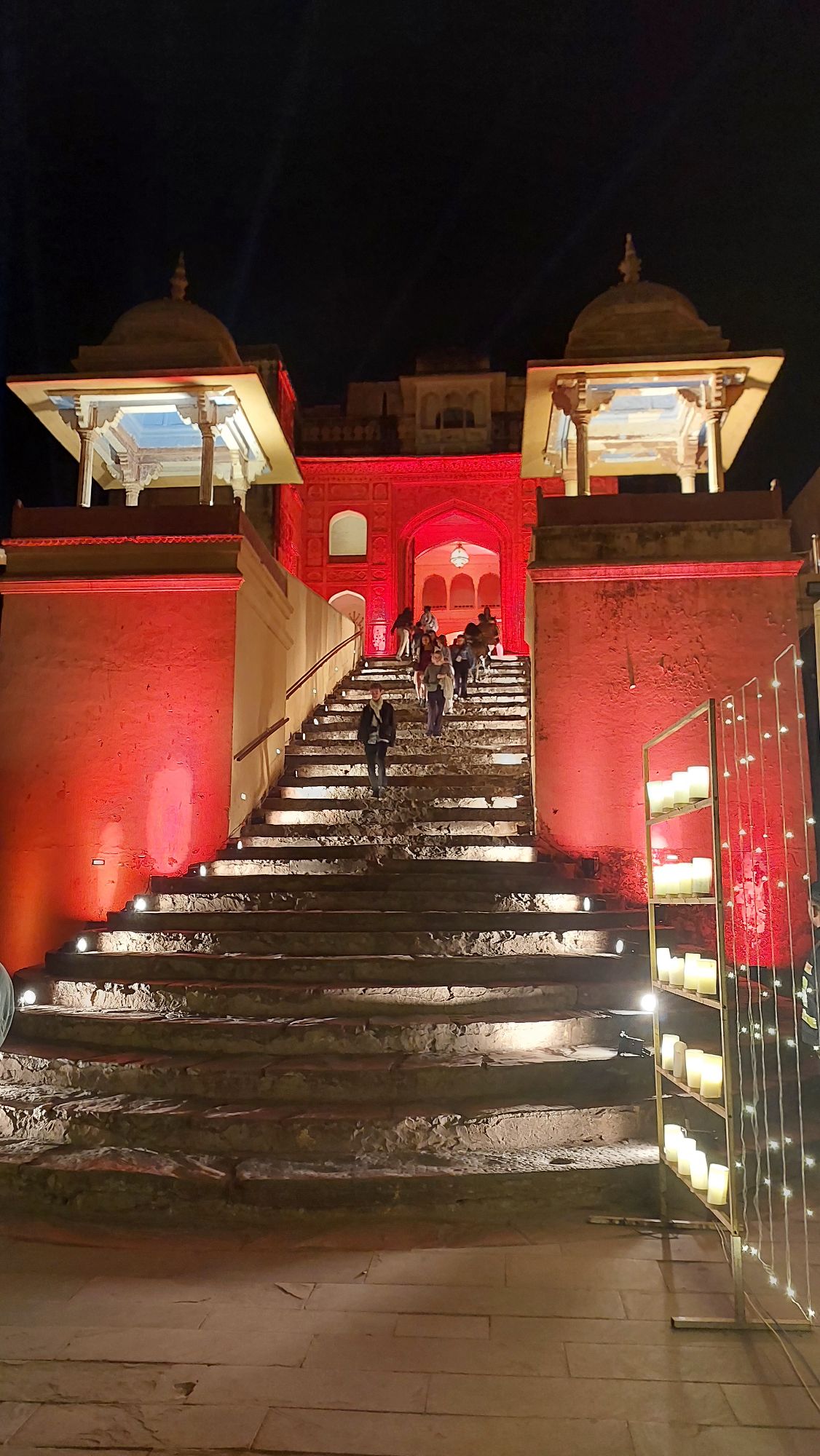
Still, the ambiences at Amer for the Heritage Night (the musical acts have been more varied and longer in tenure in previous years) were soulful and stunning as always. Couldn’t quite understand the larger crowds and the long lines for dinner, though.

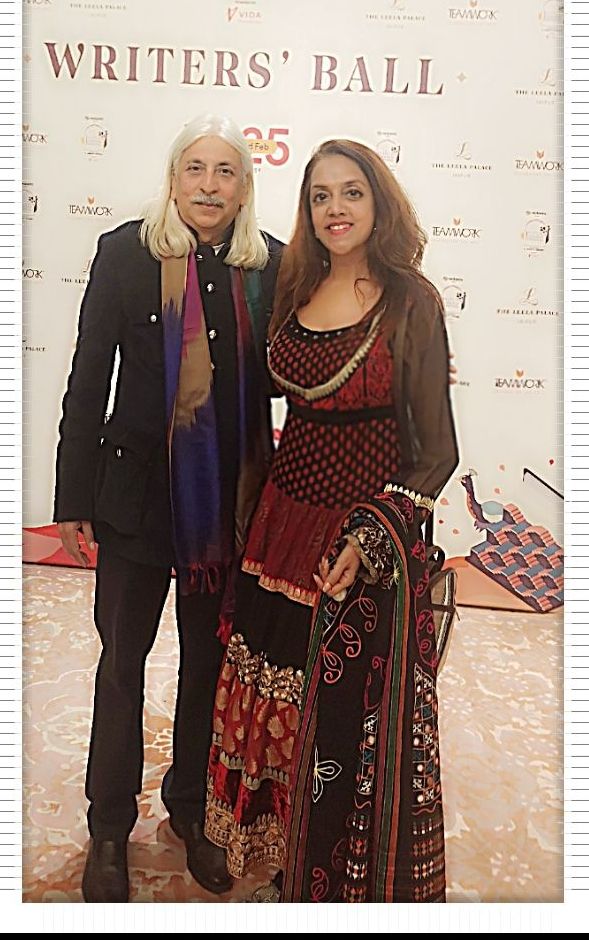
The Writer’s Ball, fortunately, was a very elegant experience, with an  exquisite assembly of authors, fabulous live counters offering Asian, Italian and Indian flavours, and a ballroom featuring a live ensemble singing with Rajasthani Sufi spirits in their hearts.

One would love to see many more sessions go up on YouTube…for as always, one would have liked to be at many more!

Intellectual greed is good!

Hoping to gain those knowledge calories over the next few months…

@jaipurliteraturefestival

@sanjoyroychoudhury

#clarksamer

#amerfort

#bookstergram

#authors

#jaipurbookmark

@
IS GENDER A FUNCTION OF THE SOUL, OR THE BODY?

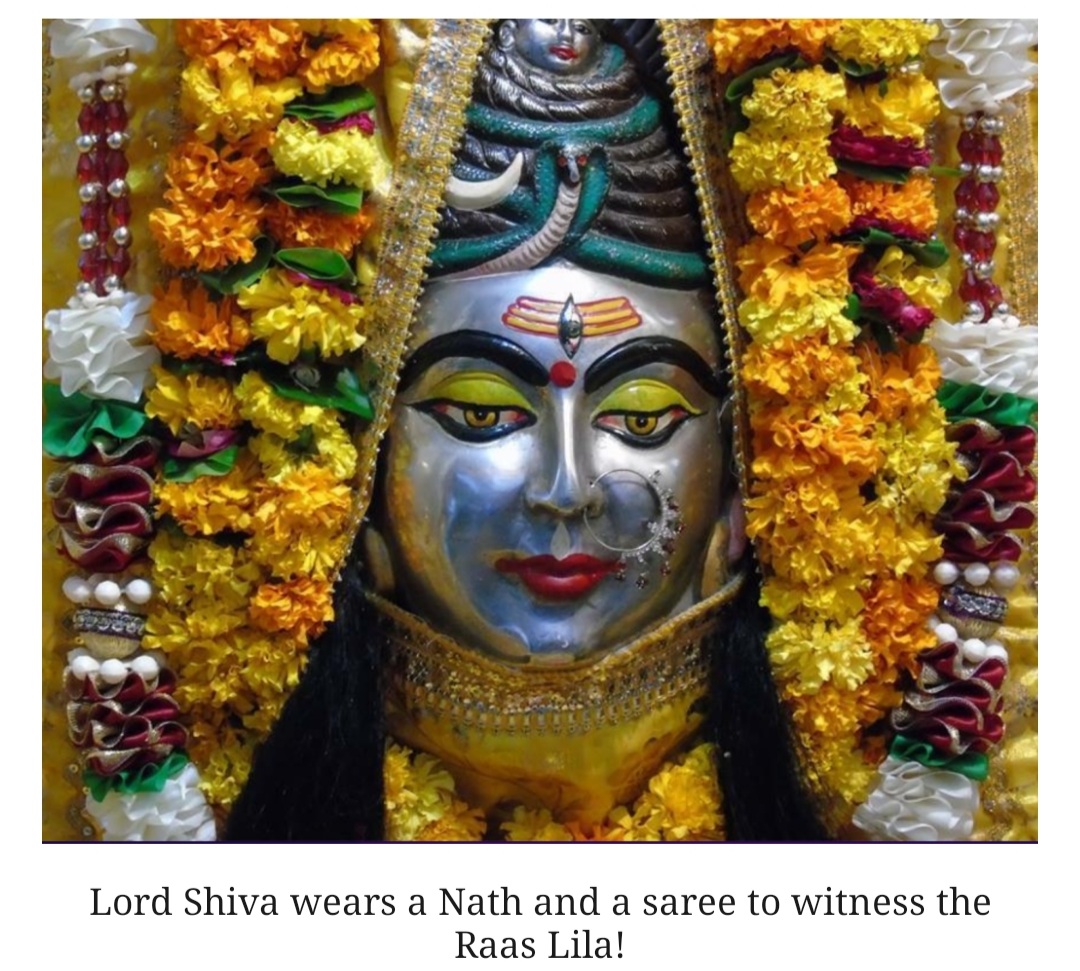
Lord Shiva wears a Nath and a saree to witness the Raas Lila!

MAINSTREAM CINEMA HAS ONLY EVER FEATURED LGBTQIA+ PERSONALITIES AS CARICATURES. CHANDIGARH… WAS THE FIRST ATTEMPT TO ZERO IN ON A TRANSGENDER HEROINE. SANGEETA WADDHWANI TALKS TO CINEMATOGRAPHER MANOJ LOBO ON THE NUANCED FILM OUTLAY TO MAKE THIS A ‘PALATABLE’ EXCURSION, AND ALSO OFFERS PERSPECTIVES FROM INDIAN MYTHOLOGY ON GENDER FLUIDITY

Through study (acquiring self-knowledge), we bridge the gap between the conscious and unconscious, the soul and ego, and the masculine and feminine.”

India’s core spiritual culture has always urged humanity to transcend dualities. So yes, while somewhere down the line, North India went the patriarchal way, and South India still held a matriarchal sway, the modern world has truly seen a flatter world between the binary of man and woman, where both are competing for the same opportunities, both operate in an information age and tech-based world, and the odds of success, truly favour grey cells over any other body part.

In the film, Chandigarh Kare Aashiqui, Vaani Kapoor’s character, Maanvi Brar, is a transgender girl. She becomes the love interest of a small-town school product, Manvinder Munjal, played by a pumped up munda, Ayushman Khurrana. She is a Zumba instructor, he is vying for a title as a heavy weight champion. The polarity is potentially perfect: An alpha-male and a hot young woman, both gym-perfect, leading independent lives. But then… they get involved… all is well between them till he pops The Question. She tells him about her sex-change journey, all hell breaks loose. The perfect couple find cracks and gaps that he, more than she, can’t bridge in his psyche.

“It’s interesting how easily a story like this could have put off a mainstream cinema audience,” I say to Manoj Lobo, the cinematographer, who admits that it was a tight-rope walk.  

“When translating words to screen, we kept it light and bright in our visual treatment. We didn’t do primary colours, we didn’t do deep shadows. To me, the fact that Maanvi was a beautiful woman, was important. The colours in the film are alive, they are happy, they pop. It is not a dark story. It is every bit a romance but with a twist.”

However, I tell Manoj, I had a little trouble ‘believing’ in Maanvi. Why? Because I had known a transgender living in my building. She was part of the jet-set elite, and that meant she had a lot of money at her disposal to ‘fix’ her body in ways that assured her of her female identity. Yet in the elevator, in her body-con dresses with plunging necklines, she would lean over and ask me, “Honey, do I look like a real woman to you?” (In fact in the end, rumour had it she died of heartbreak and excessive fiddling around with surgeries and hormones, at a rave in Goa!)

In this film, Maanvi was constantly and consistently ‘prettified’ and any hints of her identity being insecure, very subtle. “There is this scene where she is walking in the park, and hears laughter behind her. She is not sure if they are laughing at her, so she removes make-up from her bag and touches up her face,” points out Manoj, while admitting it was subtle.  

Other than the insecurities she expresses to her butch-bestie, about her fear of getting ‘dumped’ by Manvinder, because relaying the truth about her gender journey to her boyfriends always resulted in ‘the end’ for her, Maanvi otherwise, seems like any other independent migrant professional settling into a new job, away from home. No hormone pills for her. No voice breaks. No ‘practicing’ a feminine walk with books on her head. No sashaying in heels with exaggerated feminine accroutements like XL eyelashes or glitter eye shadow.

“Yes, we did meet a host of transgendered individuals, spanning all walks of society – even the ones for whom investing in the transition wasn’t that easy – but more important, we even met their partners. Because an important question was, whose story were we going to focus on? Gattu (Abhishek Kapoor) the Director was quite clear that it has to be the man’s story… a man who understands and accepts this person,” admits scriptwriter Supratik Sen. “Well ok, ‘accept’ is a big word, but at least understanding a transgender girl, is also a huge shift. And we were sure Maanvi’s character would be strong; no ‘come to my rescue’ or ‘damsel in distress’ kind of thing. The idea was for the man to step up and take the plunge. The onus was on him, to grow, evolve.”

It was a happy if uneasy ending… with a lot of unanswered questions that one would imagine a ‘hero’ seeking normality would ask…. Like how about children? Would Manvinder go to a surrogate for a family?

But let Bollywood do what it does best – tease its audience with gentle provocation. It is after all, a mass medium and the masses “respond to art and beauty far more readily than just information. So we used that route to primarily sensitize people to the trans-community. There is a lot of misinformation, a lot of phobia. Art and beauty open people’s hearts and creates empathy where otherwise there would be none,” as Manoj explains.

It is ironic that cinema is taking India back to her own highly inclusive, gender-flexible culture. In Indian myth, as mythologist Devdutt Pattnaik has often shared with audiences at various lit fests, there is room for every kind of being between the male and female polarity.

“Read the Tulsi Ramayana, from 500 years ago. He talks about how God allows all creatures inside Him: ‘Chara, char (plants, animals), Nar, Napunsak, Nari (so Man, Queer and Woman). The literal translation of Na-Pun-Sak is, ‘Not Quite A Man.’”

One doesn’t see such individuals mentioned in Abrahamic faiths (Judaism, Islam, Christianity), or Greek myth. “In Greece, one sees Man-boy love, but not a Third gender. In Greek lore, you do see powerful women not associated with men at all… like Goddess Athena, who has no male consort or lover. However, Hinduism alone had a term like Napunsak, a word for a Third Gender; it is a philosophy that speaks of diversity, obsessively.”

Years ago, I recall hearing Lakshmi Narayan Tripathi, a celebrated transgender speaker, choreographer, artiste and an activist, speaking at a public platform at the US Consulate in Mumbai, about how ancient India had very clearly defined roles for the transgendered. She talked of how they guarded the women’s quarters in palaces (zenanas), they entertained (some renowned Lucknowi courtesans were transgenderered), and they went about with their ‘maang ti’ or asking for alms in exchange for blessings metted out to newborn babies, or other major auspicious occasions. They were respected and had a clearly defined social role with income streams.

A lot of their relevance is lost in a modern nation.

This is a direct consequence, in many cases, of India’s invaders. “While the Mughals brought the word ‘hijra’ – the root word was ‘haj’ and conveyed a journey, the Mughals still had a place for the transgendered in their palaces. However, the British criminalised love between transgenders and homosexuals, throwing them outside the frameworks of ‘legal and respectable’ society, with Article 377.  India only negated that two-century old legal framework, in 2018. The gay, bisexual, lesbian population may have had to go underground, but the highly divergent ‘hijras’ were reduced to beggary. They were marginalized at every level – mental, emotional, physical, economic, social.

However, the Third Gender community has plenty of support from deep within India’s literatures – spiritual sagas that show gender-fluidity to be the path walked by all… from the Hindu Trinity to the demigods and goddesses.

“Go to Vrindavana, in Uttar Pradesh, and you will come across the Gopeshwara Temple, where Lord Shiva’s face, carved in the shape of a Shiva Linga, wears a Nath. Legend goes that the alpha-male Shiva wanted to witness Lord Krishna’s Raas Lila, but the Yamuna river did not permit him entry, telling Him only women were allowed to dance with the Lord. So Shiva transformed into a gopika,” mythologist, historian Devdutt Pattanaik had shared at a Queer Lit Fest in 2017.  

Devdutt also shared the story of another God, Aruna, the God of Twilight, who becomes a woman as he wants to see the apsaras dance. Lord Indra falls for Aruna’s female form, has a child with her, who becomes Bali. She also has a son with Surya, called Sugreeva. “Both are sons of an ‘assumed’ woman, who was initially a man!” we are reminded.

Lord Vishnu becomes Mohini to ensure the Devas get all the nectar

One of my favourite stories showing gender-fluidity by Lord Vishnu, was that of  the churning of the Ocean of Milk. With the devas positioned on one side, and the asuras on the other, the idea was to churn the Ocean of Milk till a jar of nectar bestowing immortality, arose. This was of course an extensive process: Mount Mandara was used as the churning rod and Vasuki, a Nagaraja who abides on Shiva’s neck, became the churning rope. Before the Samudra Manthana process could release the nectar, it released a number of things. One of them was the lethal poison known as Halahala. Towards the end of the churning, the devas fear that the asuras might take the pot of nectar first and finish all its contents before they get a chance to drink. So lo.. Lord Vishnu finds the perfect solution. He takes the form of a beautiful woman, Mohini, who enchants the Asuras so they don’t dare question her when she first serves nectar to the devas. By the time she finishes pouring the golden fluid into the last deva’s glasses, there is none left for them!

These stories – and many more – reveal that in Hindu lore, bodies are fluid. Gender identities are fluid. Lord Krishna is Himself an embodiment of both masculine bravery and feminine lasya; we can see him buying silks, wearing kaajal, playing the flute, contemplating nature, enjoying sandalwood body pastes – if we saw a man today with such a harmonious blend of both, warrior and musician, dancer and strategist, what would we think or say?

Let’s think of the Tribhanga pose. It is a feminine, curved stance, that Lord Krishna adopts, when playing the flute. It implies that flexibility is feminine, grace is feminine.

‘Gender is a mind-thing. Gender can be bent. Souls goof up when choosing which gender to be born in. Let’s give dignity back to those standing between binaries’

SANGEETA WADDHWANI

This resonates with a wonderful exposition by Manoj Lobo, about the film being a “curved story in a straight city. Chandigarh is built like a wire mesh. It is a grid.” In many ways, the mentality left by the British, too, was a mesh. But Lobo’s recent experiences show that the kinnars have not all lost touch with ancient systems known to their community. He recently spent two days filming 35 prominent kinnars, who came from north-south-east-west India, to a conference in a hotel in Delhi. “The idea was for them to come up with a Vision and Mission Statement, and even a Tagline. These are ways the community can build a modern identity and be immediately understood, like how you have Amul, synonymous with The Taste of India. It takes a lot of conversations and insights to come up with these statements and taglines… and I was filming all of that!”

Manoj goes on to reveal how vibrant the community is. “Some are doing social work through NGOs in Jaipur, others are even rescuing victims of natural disasters, like victims in Odisha. To this day, they have their own guru-chela system, their own gharanas, (yes, like classical music schools), even their own Akhaada during the Kumbh. There are 12 Akhaadas, all belonging to males, none for women… but one Akhaada solely for kinnars!”

As I move away from this blog, I remember how utterly hilarious gender fluidity has been in classical films like Hollywood’s Mrs Doubtfire, (and India’s saucy take with Kamal Hassan in the lead, Chikni Chaachi!) As Tantric lore says, we are all a combination of Shiv-and-Shakti. And in fact, one of Sadhguru’s books taught me that more dominating souls tend to choose a woman’s body, while more passive souls choose a male body.

At the end of Chandigarh Kare Aashiqui, we see a strong, dignified female spirit in Maanvi, who gamely reminds her lover that “I didn’t reject you, you rejected me.” However, to give Gattu credit, the character really doesn’t want sympathy. She just wants to Be.

It is only in asides that we see Maanvi’s inner struggles when she talks to her father… who feels, how long can this boy-turned-girl battle this world, how long can she be by herself, was she not exhausted always standing alone?

Fortunately, the movie offers hope…. We do not know how many transgendered girls find such silver linings, but the movie gifts a different perspective to mainstream India.

Gender is a mind-thing. Gender can be bent. Souls can goof up when choosing a gender to be born in. And then, some choose to walk the earth representing Shiv-Shakti in one body. Like Puttaparthi Sai Baba did. Let’s acknowledge our inclusive culture, inclusive stories, inclusive avataars, and give dignity back to those standing between binaries.

CAITLYN JENNER WAS BORN WILLIAM BRUCE JENNER IN 1949.

ART AS A NUDITY OF SPIRIT

GET TRANSPORTED BY SHILO SHIV SULEMAN

SANGEETA WADDHWANI BRINGS YOU A VIVID ENCOUNTER OF THE FEMINIST ARTISTIC KIND…WALKING THROUGH AN EXHIBITION WITH THE TALENTED SILO SULEMAN AT ART MUSINGS, MUMBAI

Here’s toasting my first ‘normal’, non-mediated art experience since lockdown! Trust the vivacious Sangeeta Raghavan of Art Musings gallery, to take this first bold step in the New Normal. I immediately took her up on the invitation to do a walk through with ‘viral” artist Shiv Silo Suleman (yes the exotic half-Muslim half Hindu creator), at the downtown gallery, a legend of a space in the annals of Mumbai’s arteratti.

Shilo is a statuesque, dusky and creatively turbo-charged young woman who strangely exudes such a spirit of transparency, her clothes seem superfluous on her! With Shilo one can see that there is no boundary really between nature, her own body-mind construct… and her art. In fact even her process is her. She merges right into her installations even as she exists independently of them.

Shilo offers a sensory meditation, as she opens the experience of our walkthrough by setting off a gong. Just the way we set off a bell when entering a temple. And lo…suspended all around the space are brass goddess body parts, suggesting a decimated, destroyed dream, an echo of Lord Shiva ferrying the carcass of his beloved, self-immolated Sati. “As parts of the Goddess fell across the body of India, temples sprouted there, enshrining each part. So Nainital is where Sati’s eyes fell, and Kamakhya Temple in Guwahati is where her womb and yoni fell,” (Yes it is well known that the goddess menstruates around June, and the surrounding Bramhaputra River turns red. There are 51 such Shakti Peeths around India.)

The mood shifts to exploring the idea of a cosmic flood..a poetic leitmotif both in our Vishnu avatar story (he is born as a tiny fish which grows until only the sea can accommodate him) and the Biblical destruction myth of Noah’s arc. Vishnu as Matsya the fish, is here to help save lives from the cyclical destruction of flooding…and accompanying this is the installation of a giant scaly brass fish, a water filled lower torso and legs of a goddess (possibly the earth), and text that repeatedly makes poetry of floods…neatly written on the floor.

The video installation showing Shilo immersed in water and carrying a giant metallic fish, has her body highlighted with gold leaf, but little else. It clearly hints of a near sexual communion with the sacred element of water…her sensual sighing is both provocative and nihilistic.

“Daily we put jal into the goddess torso, we ring the gong, we offer flowers to the heart sculpture downstairs, we treat this as a sacred, living space, My practice is going more and more in this direction,” she explains.

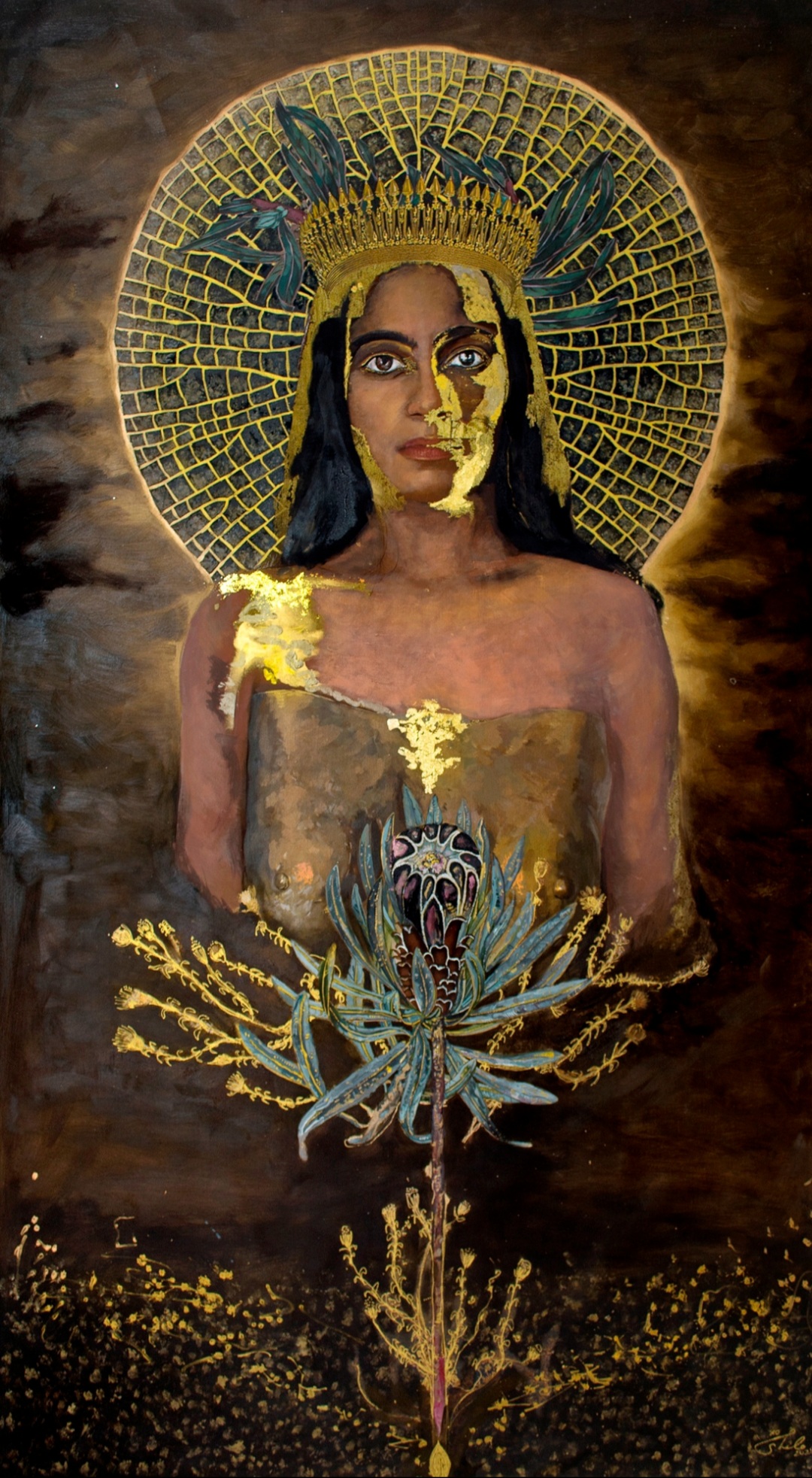
As we walk down to the first level, we see stunning canvas iterations of her themes, figurative works with a restrained colour palette, trademark gold leaf highlights, merging all that’s earthy with all that’s precious. “This work is called Sovereign and it is about how the only ruling force or crown I bow down to, is nature. That’s the only Empire,” she explains, adding, “And guess what..Corona means Crown!”

They say all true artists create not from only the personal but also channel the Universal. I point out that the primordial ‘story’ under the Pandemic is to worship back at the altar of nature – not Fast Fashion, not new concrete towers, or ozone busting gadgets or air travel. Shilo agrees. And this is why her works feel so gently wild…they are layered wildernesses… celebrating the sensuality of flowers, soil, raw gold, and the beauty of the female form.

“Like the Earth, the female form has been inducted into the language of consumerism, commodified…” I say. She agrees. Whether it is the display of goddess body parts, or a chastity belt (symbolizing the societal takeover of female sexuality), or her Kahloesque nudes, self portraits showing shadow selves, she nudges at the sexual sell which has nothing to do with the wholesome beauty of unfettered femaleness. “Women need to reclaim their wholesomeness..away from the projections that sell movies, products, perpetuate false womanhood,” she concurs. I can’t resist telling her how my last book, Mind the Gap! explores the same idea..

I am then deeply moved when we enter the “heartspace” of her exhibit, where a wittily recreated brass human heart appears to have a human face. Shilo, like many young women, has experienced the profound pain of heartbreak, but as she is so philosophically aligned to ideas of reincarnation and seeds regenerating in cyclical rhythms, one sees an eternal romantic in handwritten letters interspersed with gold leaf; “Containing some true expressions of love, some orchestrated,” she shares. She borrows from Urdu literature, quoting the legendary Faiz Ahmad Faiz in a painting, and borrows from Islamic architectural ideas in an impressive life-sized monument to.love. The monument is clearly inspired by nostalgia; to earthly delights showing the heavenly sentiment of romantic attachment

There is so much passion and earthiness in both Shilo and her show, one leaves feeling that even if humanity has forgotten the sacred in the ‘consumption’ of the feminine, has forgotten the delicate grace of ritual and the writing of love letters…has even lost touch with the diurnal beauty of sunrises and sunsets, a show like this will nudge at such amnesia…it bears the signature of the times, pregnant with nostalgia and hope, sensuality and surrender…

Little wonder I never forgot seeing Shilo’s work at the India Art Fair back in 2018! She is traveling along an honest path, one that is healing to view and encounter.

The show, titled We Meet Here from the Afterlife, will be on display till March 27 at Art Musings gallery, Colaba, Mumbai