


MAINSTREAM CINEMA HAS ONLY EVER FEATURED LGBTQIA+ PERSONALITIES AS CARICATURES. CHANDIGARH… WAS THE FIRST ATTEMPT TO ZERO IN ON A TRANSGENDER HEROINE. SANGEETA WADDHWANI TALKS TO CINEMATOGRAPHER MANOJ LOBO ON THE NUANCED FILM OUTLAY TO MAKE THIS A ‘PALATABLE’ EXCURSION, AND ALSO OFFERS PERSPECTIVES FROM INDIAN MYTHOLOGY ON GENDER FLUIDITY
“Through study (acquiring self-knowledge), we bridge the gap between the conscious and unconscious, the soul and ego, and the masculine and feminine.”
India’s core spiritual culture has always urged humanity to transcend dualities. So yes, while somewhere down the line, North India went the patriarchal way, and South India still held a matriarchal sway, the modern world has truly seen a flatter world between the binary of man and woman, where both are competing for the same opportunities, both operate in an information age and tech-based world, and the odds of success, truly favour grey cells over any other body part.
In the film, Chandigarh Kare Aashiqui, Vaani Kapoor’s character, Maanvi Brar, is a transgender girl. She becomes the love interest of a small-town school product, Manvinder Munjal, played by a pumped up munda, Ayushman Khurrana. She is a Zumba instructor, he is vying for a title as a heavy weight champion. The polarity is potentially perfect: An alpha-male and a hot young woman, both gym-perfect, leading independent lives. But then… they get involved… all is well between them till he pops The Question. She tells him about her sex-change journey, all hell breaks loose. The perfect couple find cracks and gaps that he, more than she, can’t bridge in his psyche.
“It’s interesting how easily a story like this could have put off a mainstream cinema audience,” I say to Manoj Lobo, the cinematographer, who admits that it was a tight-rope walk.
“When translating words to screen, we kept it light and bright in our visual treatment. We didn’t do primary colours, we didn’t do deep shadows. To me, the fact that Maanvi was a beautiful woman, was important. The colours in the film are alive, they are happy, they pop. It is not a dark story. It is every bit a romance but with a twist.”
However, I tell Manoj, I had a little trouble ‘believing’ in Maanvi. Why? Because I had known a transgender living in my building. She was part of the jet-set elite, and that meant she had a lot of money at her disposal to ‘fix’ her body in ways that assured her of her female identity. Yet in the elevator, in her body-con dresses with plunging necklines, she would lean over and ask me, “Honey, do I look like a real woman to you?” (In fact in the end, rumour had it she died of heartbreak and excessive fiddling around with surgeries and hormones, at a rave in Goa!)
In this film, Maanvi was constantly and consistently ‘prettified’ and any hints of her identity being insecure, very subtle. “There is this scene where she is walking in the park, and hears laughter behind her. She is not sure if they are laughing at her, so she removes make-up from her bag and touches up her face,” points out Manoj, while admitting it was subtle.
Other than the insecurities she expresses to her butch-bestie, about her fear of getting ‘dumped’ by Manvinder, because relaying the truth about her gender journey to her boyfriends always resulted in ‘the end’ for her, Maanvi otherwise, seems like any other independent migrant professional settling into a new job, away from home. No hormone pills for her. No voice breaks. No ‘practicing’ a feminine walk with books on her head. No sashaying in heels with exaggerated feminine accroutements like XL eyelashes or glitter eye shadow.
“Yes, we did meet a host of transgendered individuals, spanning all walks of society – even the ones for whom investing in the transition wasn’t that easy – but more important, we even met their partners. Because an important question was, whose story were we going to focus on? Gattu (Abhishek Kapoor) the Director was quite clear that it has to be the man’s story… a man who understands and accepts this person,” admits scriptwriter Supratik Sen. “Well ok, ‘accept’ is a big word, but at least understanding a transgender girl, is also a huge shift. And we were sure Maanvi’s character would be strong; no ‘come to my rescue’ or ‘damsel in distress’ kind of thing. The idea was for the man to step up and take the plunge. The onus was on him, to grow, evolve.”
It was a happy if uneasy ending… with a lot of unanswered questions that one would imagine a ‘hero’ seeking normality would ask…. Like how about children? Would Manvinder go to a surrogate for a family?
But let Bollywood do what it does best – tease its audience with gentle provocation. It is after all, a mass medium and the masses “respond to art and beauty far more readily than just information. So we used that route to primarily sensitize people to the trans-community. There is a lot of misinformation, a lot of phobia. Art and beauty open people’s hearts and creates empathy where otherwise there would be none,” as Manoj explains.
It is ironic that cinema is taking India back to her own highly inclusive, gender-flexible culture. In Indian myth, as mythologist Devdutt Pattnaik has often shared with audiences at various lit fests, there is room for every kind of being between the male and female polarity.
“Read the Tulsi Ramayana, from 500 years ago. He talks about how God allows all creatures inside Him: ‘Chara, char (plants, animals), Nar, Napunsak, Nari (so Man, Queer and Woman). The literal translation of Na-Pun-Sak is, ‘Not Quite A Man.’”
One doesn’t see such individuals mentioned in Abrahamic faiths (Judaism, Islam, Christianity), or Greek myth. “In Greece, one sees Man-boy love, but not a Third gender. In Greek lore, you do see powerful women not associated with men at all… like Goddess Athena, who has no male consort or lover. However, Hinduism alone had a term like Napunsak, a word for a Third Gender; it is a philosophy that speaks of diversity, obsessively.”
Years ago, I recall hearing Lakshmi Narayan Tripathi, a celebrated transgender speaker, choreographer, artiste and an activist, speaking at a public platform at the US Consulate in Mumbai, about how ancient India had very clearly defined roles for the transgendered. She talked of how they guarded the women’s quarters in palaces (zenanas), they entertained (some renowned Lucknowi courtesans were transgenderered), and they went about with their ‘maang ti’ or asking for alms in exchange for blessings metted out to newborn babies, or other major auspicious occasions. They were respected and had a clearly defined social role with income streams.
A lot of their relevance is lost in a modern nation.
This is a direct consequence, in many cases, of India’s invaders. “While the Mughals brought the word ‘hijra’ – the root word was ‘haj’ and conveyed a journey, the Mughals still had a place for the transgendered in their palaces. However, the British criminalised love between transgenders and homosexuals, throwing them outside the frameworks of ‘legal and respectable’ society, with Article 377. India only negated that two-century old legal framework, in 2018. The gay, bisexual, lesbian population may have had to go underground, but the highly divergent ‘hijras’ were reduced to beggary. They were marginalized at every level – mental, emotional, physical, economic, social.
However, the Third Gender community has plenty of support from deep within India’s literatures – spiritual sagas that show gender-fluidity to be the path walked by all… from the Hindu Trinity to the demigods and goddesses.
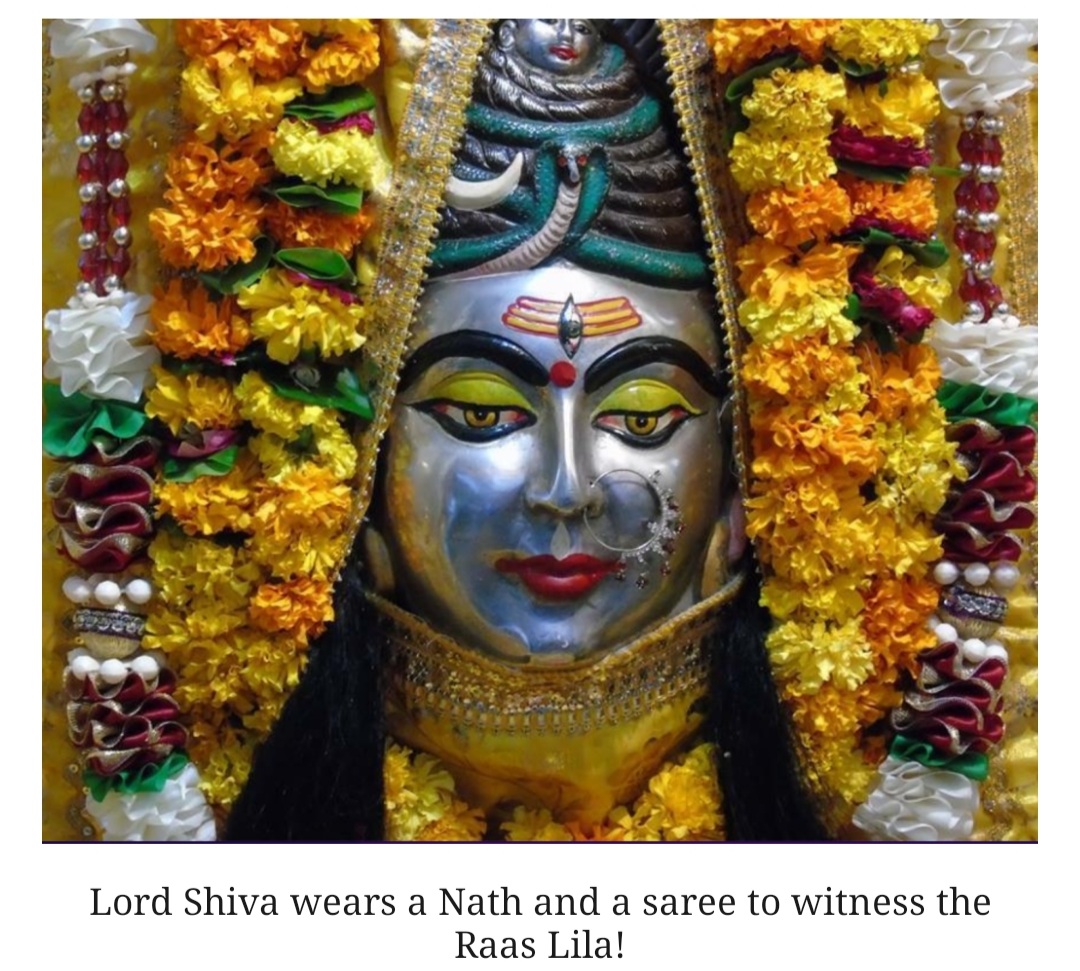
“Go to Vrindavana, in Uttar Pradesh, and you will come across the Gopeshwara Temple, where Lord Shiva’s face, carved in the shape of a Shiva Linga, wears a Nath. Legend goes that the alpha-male Shiva wanted to witness Lord Krishna’s Raas Lila, but the Yamuna river did not permit him entry, telling Him only women were allowed to dance with the Lord. So Shiva transformed into a gopika,” mythologist, historian Devdutt Pattanaik had shared at a Queer Lit Fest in 2017.
Devdutt also shared the story of another God, Aruna, the God of Twilight, who becomes a woman as he wants to see the apsaras dance. Lord Indra falls for Aruna’s female form, has a child with her, who becomes Bali. She also has a son with Surya, called Sugreeva. “Both are sons of an ‘assumed’ woman, who was initially a man!” we are reminded.

One of my favourite stories showing gender-fluidity by Lord Vishnu, was that of the churning of the Ocean of Milk. With the devas positioned on one side, and the asuras on the other, the idea was to churn the Ocean of Milk till a jar of nectar bestowing immortality, arose. This was of course an extensive process: Mount Mandara was used as the churning rod and Vasuki, a Nagaraja who abides on Shiva’s neck, became the churning rope. Before the Samudra Manthana process could release the nectar, it released a number of things. One of them was the lethal poison known as Halahala. Towards the end of the churning, the devas fear that the asuras might take the pot of nectar first and finish all its contents before they get a chance to drink. So lo.. Lord Vishnu finds the perfect solution. He takes the form of a beautiful woman, Mohini, who enchants the Asuras so they don’t dare question her when she first serves nectar to the devas. By the time she finishes pouring the golden fluid into the last deva’s glasses, there is none left for them!
These stories – and many more – reveal that in Hindu lore, bodies are fluid. Gender identities are fluid. Lord Krishna is Himself an embodiment of both masculine bravery and feminine lasya; we can see him buying silks, wearing kaajal, playing the flute, contemplating nature, enjoying sandalwood body pastes – if we saw a man today with such a harmonious blend of both, warrior and musician, dancer and strategist, what would we think or say?
Let’s think of the Tribhanga pose. It is a feminine, curved stance, that Lord Krishna adopts, when playing the flute. It implies that flexibility is feminine, grace is feminine.
‘Gender is a mind-thing. Gender can be bent. Souls goof up when choosing which gender to be born in. Let’s give dignity back to those standing between binaries’
SANGEETA WADDHWANI
This resonates with a wonderful exposition by Manoj Lobo, about the film being a “curved story in a straight city. Chandigarh is built like a wire mesh. It is a grid.” In many ways, the mentality left by the British, too, was a mesh. But Lobo’s recent experiences show that the kinnars have not all lost touch with ancient systems known to their community. He recently spent two days filming 35 prominent kinnars, who came from north-south-east-west India, to a conference in a hotel in Delhi. “The idea was for them to come up with a Vision and Mission Statement, and even a Tagline. These are ways the community can build a modern identity and be immediately understood, like how you have Amul, synonymous with The Taste of India. It takes a lot of conversations and insights to come up with these statements and taglines… and I was filming all of that!”
Manoj goes on to reveal how vibrant the community is. “Some are doing social work through NGOs in Jaipur, others are even rescuing victims of natural disasters, like victims in Odisha. To this day, they have their own guru-chela system, their own gharanas, (yes, like classical music schools), even their own Akhaada during the Kumbh. There are 12 Akhaadas, all belonging to males, none for women… but one Akhaada solely for kinnars!”
As I move away from this blog, I remember how utterly hilarious gender fluidity has been in classical films like Hollywood’s Mrs Doubtfire, (and India’s saucy take with Kamal Hassan in the lead, Chikni Chaachi!) As Tantric lore says, we are all a combination of Shiv-and-Shakti. And in fact, one of Sadhguru’s books taught me that more dominating souls tend to choose a woman’s body, while more passive souls choose a male body.
At the end of Chandigarh Kare Aashiqui, we see a strong, dignified female spirit in Maanvi, who gamely reminds her lover that “I didn’t reject you, you rejected me.” However, to give Gattu credit, the character really doesn’t want sympathy. She just wants to Be.
It is only in asides that we see Maanvi’s inner struggles when she talks to her father… who feels, how long can this boy-turned-girl battle this world, how long can she be by herself, was she not exhausted always standing alone?
Fortunately, the movie offers hope…. We do not know how many transgendered girls find such silver linings, but the movie gifts a different perspective to mainstream India.
Gender is a mind-thing. Gender can be bent. Souls can goof up when choosing a gender to be born in. And then, some choose to walk the earth representing Shiv-Shakti in one body. Like Puttaparthi Sai Baba did. Let’s acknowledge our inclusive culture, inclusive stories, inclusive avataars, and give dignity back to those standing between binaries.

 LIFE OF A MAGAZINE EDITOR