
ANIMAL: FAMILY WARS, PRIMAL ANGST, BLOODBATHS AND A DESI TARANTINO IS BORN

FAMILY FISSURES AND THEIR SUBCONSCIOUS DRAMAS HAVE BEEN A SUBJECT OF MANY AN EPIC – BE IT A HAMLET HAUNTED BY HIS MOTHER’S HASTY REMARRIAGE AFTER WIDOWHOOD, TO OEDIPUS ACTUALLY MARRYING HIS MOTHER UNKNOWINGLY…TO THE LEGENDARY MAHABHARAT, A BATTLE PITTING KIN AGAINST KIN, GURU AGAINST SHISHYA…SO WHAT IS THE PROBLEM WITH ANIMAL? SANGEETA WADDHWANI ESSAYS AN ANSWER…

In the Hindu treatise of theatre and storytelling, the Natyashastra, all forms of narrative had one soul purpose..to enforce higher moral values on a society. Particularly among the unlettered, who had no direct way to read the spiritual texts meant to throw light on their journeys.

If you look at the basic message of the Bhagavad Gita, it was to show Prince Arjuna that the battle for good vs evil transcends family ties. Every effort was made to negotiate fair terms for both the Pandavas and Kauravas…but when the Kauravas remained mired in greed and injustice, Lord Krishna Himself told Arjuna this was a battle of values, and it would be dharmically correct to vanquish the Kauravas, as souls migrate from body to body, and filial ties are temporal.

When the lead character of ANIMAL, Ranvijay (Vijay) Singh, played by Ranbir Singh, makes a poetic reference to this great epic, the Mahabharat- it is close to the end of the movie, and sadly, a surface reference.

Ranvijay grows up with a deep void, a father-son wound. We first see him as a child who grows up seeking a father who will show him tenderness, concern, love….even while he hero-worships the man at the helm of Shakti Steels…the behemoth family corporation. This is a highly relateable scenario with children born to uber successfull fathers who are just never really there for their children.

In my own journalism journey, I have had a Shah Rukh Khan’s tell me that he has been a better father to little AbRam than to Aryan and Suhana…as he was too busy building his career when the first two children came into his world. “AbRam hangs out on the set, happily…my other two kids had no inclination really to see me at work! I take AbRam to IPL matches…everywhere little kids can go!” he had shared, his eyes all lit up above those disarming dimples.

Ranbir Kapoor had confessed to me that he had a father wound, too. In real life, Rishi Kapoor demanded a certain protocol and distance as a father. He wasn’t inclined to be buddy-buddy…so if Ranbir needed warmth, spontaneous affection, or to offload some trauma..it was mommy Neetu he turned to.

This basic backstory of a father-son wound as an emotional blueprint for Ranvijay Singh, was highly relateable. BUT…one is not so sure it would make an ANIMAL out of a young boy. The question that kept arising in my mind, was, does such a wound insist on creating a homicidal-prone adult?

Also, how plausible is it, that a son who has been exiled by his father, to boarding school, (for avenging the ragging of his sister in a school owned by their family)… is willing to put life and limb on the line when this brute father, Balbir Singh, deals with…and miraculously…survives a threat to his life?

At the viscerel level, Sandeep Reddy Vanga as screenwriter and film-maker, has touched explosive material within Ranbir… Gone is the rather understated method actor who won accolades as the sensitive Barfi who befriends the autistic Jhilmil Chatterjee, or the jilted lover Ayan, who suffers many scenes of unrequited love with Anizeh in Ae Dil Hai Mushkil.
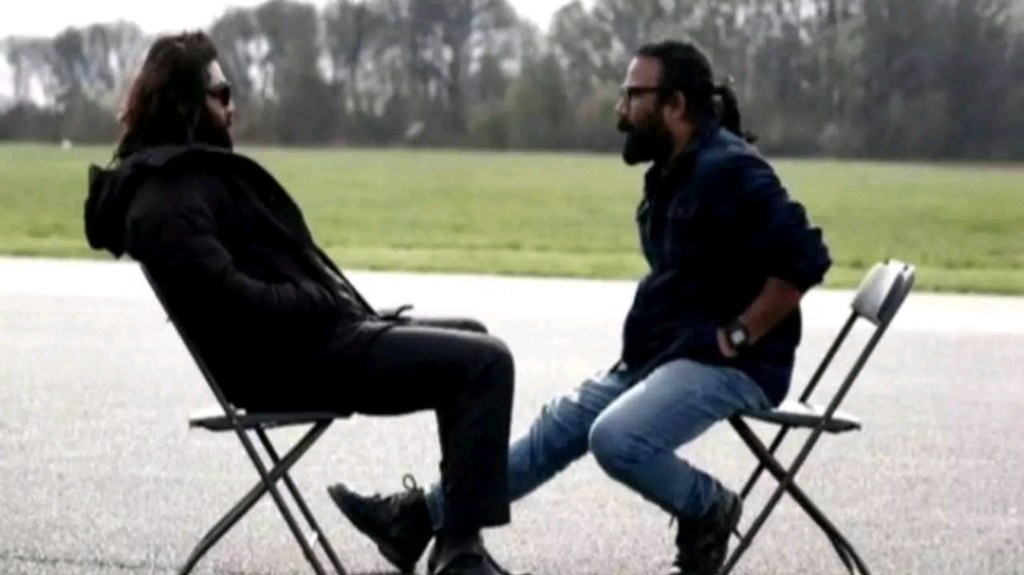
RANBIRVWITH SANDEEP REDDY VANGA

After a long, dry spell Ranbir has been thrown into the deeper trenches of inhabiting an atypical dark hero…something we have seen a Ranveer Singh take on brilliantly as Allaudin Khilji or even as a hyper ambitious Maratha warrior, Bajirao.

SANDEEP RESURRECTS A SUPERSTAR

One won’t be surprised if Sandeep had a pseudo bromance with his leading actor, so intense is this physical revamp. And so hyped is the tagline in the credits and film poster: ‘Starring Superstar Ranbir Kapoor’. It is good to see Ranbir stretching his acting chops, letting Sandeep push him off the proverbial cliff, so he is free to take flight guided by his inner demons.

Yes, in the romantic scenes, which build your appetite to watch the movie, there is a begiiling mix of soft, intoxicating, hooded Kapoor caramel eyes meeting a confident ‘all brawn and primal brain’ swag. Seductive.

THOSE RANVEERIAN TRICKS!

100s of hours of brutal workouts brought about a transformation for Ranbir

One does love the lush, rougish mane Ranbir has adopted, that has also worked like a charm for Ranveer in Rocky aur Rani. We also see him exude a far more sexually self-aware aura… frequently bare chested….again a very Ranveerian trend.

Yes the script does warn us that Ranvijay is alpha male….The very first encounter with his heroine (artfully played by Rashmika Mandanna) warns us of this. The scene? She is set to marry a man introduced to her by family, who she has barely met, but who represents brighter job prospects for her humble, middle class self.

Seeking to throw his childhood lady love a rope to pull her out of such a mediocre partnership, he tells his sweetheart that she is marrying a man who could never hunt, feed and protect his woman…unlike an alpha male (like himself). He hints that the archetype she has chosen to marry (who represents brain power over brawn), wins women over by poetry. In other words, a loser! And to add to that primal vision of the world, he compliments her broad child-bearing pelvis structure, ideal for bearing his children.

Many women have found such dialogues misogynistic, not sexy at all and certainly not in synch with a world filled with alpha females doing the breadwinning, and delegating children to a much later time in life, if at all, or going to surrogates. Clearly, this film prefers to have overtones of the Neanderthal Man (as Shobhaa De says, in her insta-post)..

So as he vows to avenge the attempt on his father’s life, we see RanVijay Singh express his monstrous propensity for self-sacrifice, putting his beautiful body on the line, bloodshedding in a 100 lyrical ways.

One can see Sandeep gunning to be a Desi Tarantino, as music often accompanies the brutal slicing off of limbs, strange masked goons being shredded solo by our troubled homicidal hero…we close our eyes, feel our hearts cringe, and wish an Interval would redeem us. Yet, this very violence is being credited for the film’s blockbuster status…480 crores at the BO…and still counting!
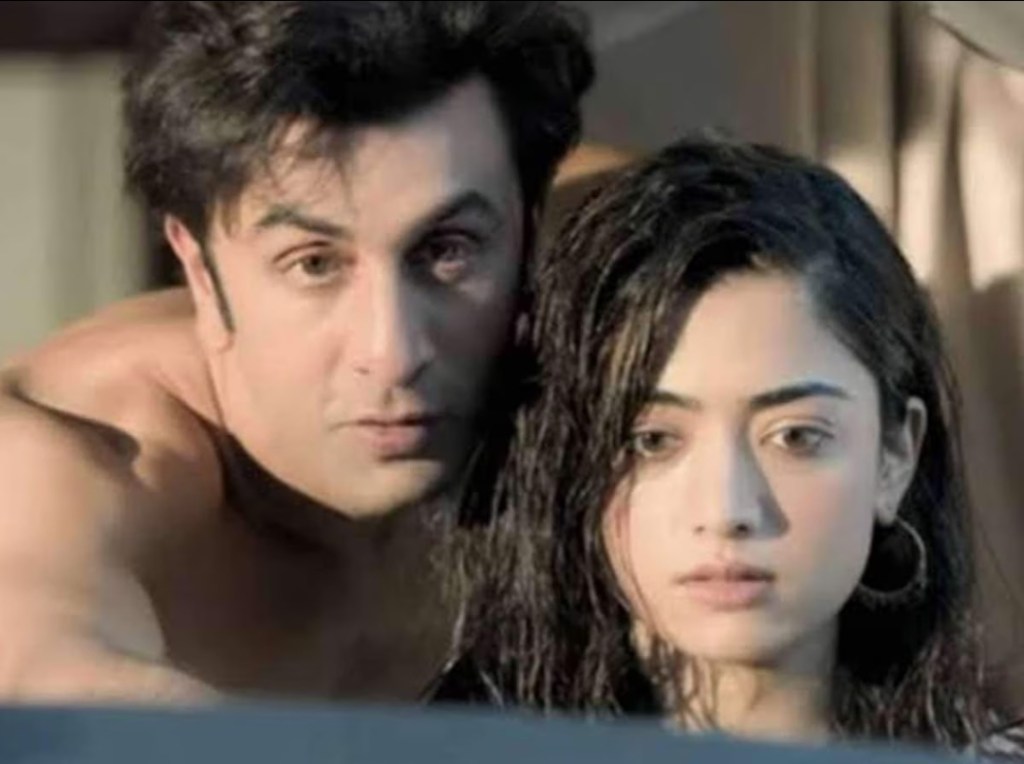
IN QUEST OF TOXIC MASCULINITY?

One wonders, what is Sandeep Reddy Vanga building towards here, in a world where masculine and feminine polarities are melting down? Is it an attempt to take us back to our animal, primal selves, or a nostalgia for a time when human society only had a simple gender binary – no spectrum of Transgender, Homosexuals, Asexuals, Demi Sexuals? A time where men hunted, plundered and lived to drink the blood of their enemies? A toxic masculinity that legitimised the shedding of blood but not tears for fears? And where women, with their child bearing hips, had little to do but keep hearth and hearts of hubby and babies healthy?.

THE WIFE IS JEALOUS OF THE MOL AND FATHER-IN- LAW

To be fair, Rashmika’s character as wife to the alpha male, was not exactly a spectator/doormat. When Ranvijay has a passing and calculated post-marital affair with his enemy’s Mol, ..she delivers some priceless screen moments as the neglected wife trying to re-imagine her husband’s transgressions…and after minutes of asking graphic questions, says words so bitter she compells him to pick up a gun and shoot.

Rashmika plays her character with a consistent streak of worldly scepticism that, to her credit, lends a modern and believable touch. She knows her husband has murdered hundreds and has no fear of his own mortality when it comes to safe guarding his father. She is jealous of that father-love. So are we.

THE BOLD AND THE IMPLAUSIBLE

At a totally logical level, though, we wonder what aspect of his father’s legacy is RanVijay looking to take on? There’s only one dialogue that shows RanVijay being a little clued in to environmental violations by his brother in law – who is entrusted with more responsibilites within Balbir Singh’s Shakti Steel company than RanVijay. Of course when RanVijay finds out that his brother-in-law was part of the attempted murder plot against his father, he finishes him off in the midst of office staff, choking him with his bare hands. Now given a modern world with CC TV cameras…shouldn’t the police have enough evidence to convict RanVijay of manslaughter? But no, Primal Cavemen heros have to go about their real business…unhindered by law and order machinery.

So off RanVijay goes, after many twists and turns of the plot, to murder a distant cousin who was gunning for Balbir’s life due to his grandfather being barred from the family business and legacy due to malpractices.

THE MOST MEMORABLE SCENE

As for a scene that DID work…for me, was when RanVijay tells his father to do some role playing. He tells his father to be the little boy who sought time with his beloved father on his birthday, but who had to see his father fully engaged with the company stocks and the mobile phone. So Balbir starts to do so…saying Papa, Papa…only to be violently rebuked at every instance, by RanVijay acting as his father, Balbir. This kind of Family Constellation therapy is actually used to heal deep family wounds in our day… and in the scene, Balbir finally relents, realising how toxic his parenting had been for his adoring, worshipping little son. In fact there is a fascinating reference to father and son switching roles across lifetimes, and RanVijay saying ‘next time around, I will be your father and will maybe treat you the same way you have treated me in this life…and this Mahabharat will go on.” To which Balbir, tearfully vows never to be such a ruthless father again.

But overall there are so many cracks in the plausibility of the narrative, it makes you want to wake up soon …as if out of a 80s potboiler stupor. I mean RanVijay nearly dies, then has a heart transplant that sees him so fit he slices his enemy’s neck with a knife. Just when we leave the theatre thinking it’s over..you see people running back up the stairs to see one last gory scene!

And you know what? Bobby Deol who plays Abrar..The arch villain whose neck is sliced by his cousin RanVijay, after a gruelling hand combat…has been quoted telling the press..”If Ranbir’s character can be resurrected by a heart transplant, maybe I too will have a miracle surgery and feature in the sequel!”

This is what makes a hit? A hit man’s fantasy?

Worried about the world we live in! And horror of horrors..a sequel is already in the works…with more violence on offer…ANIMAL PARK! Why not just check this whole cray cray family into therapy? Rashmika’s character would so agree!
IS GENDER A FUNCTION OF THE SOUL, OR THE BODY?

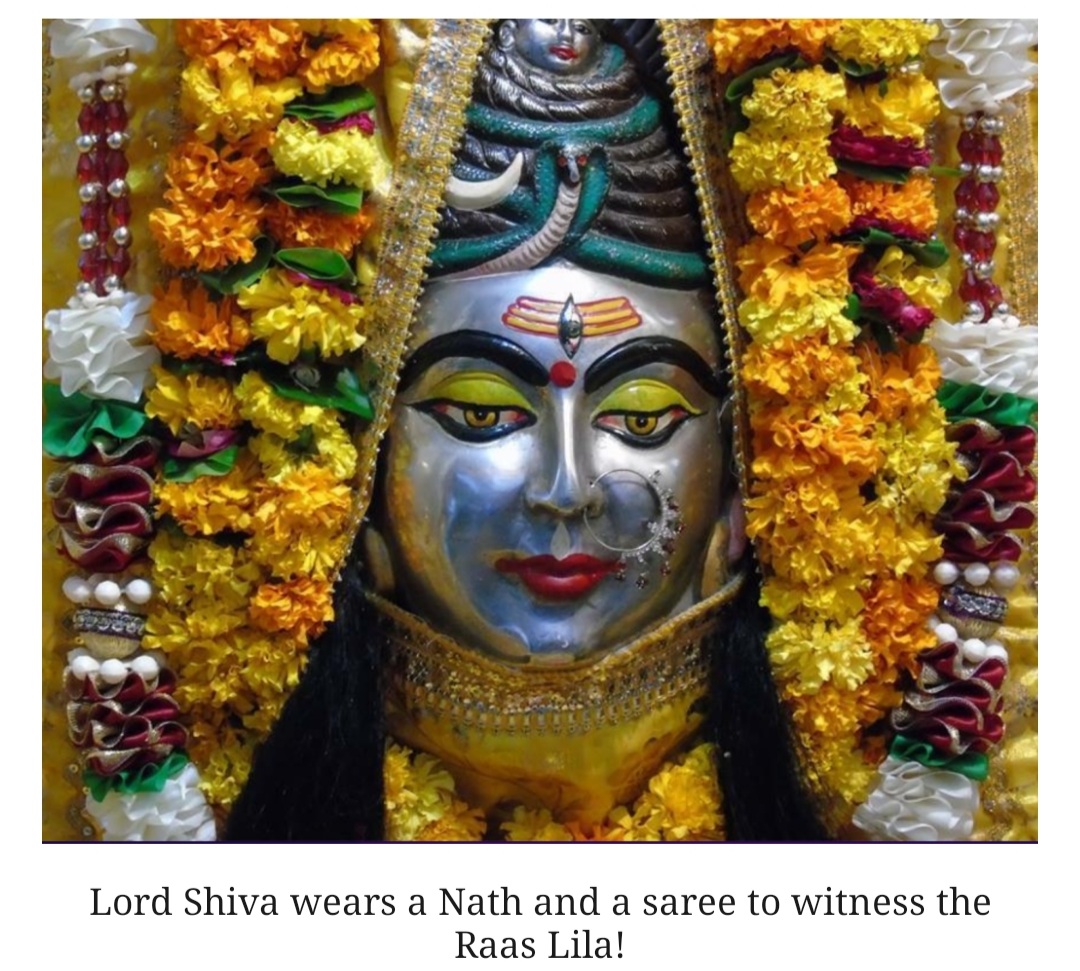
Lord Shiva wears a Nath and a saree to witness the Raas Lila!

MAINSTREAM CINEMA HAS ONLY EVER FEATURED LGBTQIA+ PERSONALITIES AS CARICATURES. CHANDIGARH… WAS THE FIRST ATTEMPT TO ZERO IN ON A TRANSGENDER HEROINE. SANGEETA WADDHWANI TALKS TO CINEMATOGRAPHER MANOJ LOBO ON THE NUANCED FILM OUTLAY TO MAKE THIS A ‘PALATABLE’ EXCURSION, AND ALSO OFFERS PERSPECTIVES FROM INDIAN MYTHOLOGY ON GENDER FLUIDITY

Through study (acquiring self-knowledge), we bridge the gap between the conscious and unconscious, the soul and ego, and the masculine and feminine.”

India’s core spiritual culture has always urged humanity to transcend dualities. So yes, while somewhere down the line, North India went the patriarchal way, and South India still held a matriarchal sway, the modern world has truly seen a flatter world between the binary of man and woman, where both are competing for the same opportunities, both operate in an information age and tech-based world, and the odds of success, truly favour grey cells over any other body part.

In the film, Chandigarh Kare Aashiqui, Vaani Kapoor’s character, Maanvi Brar, is a transgender girl. She becomes the love interest of a small-town school product, Manvinder Munjal, played by a pumped up munda, Ayushman Khurrana. She is a Zumba instructor, he is vying for a title as a heavy weight champion. The polarity is potentially perfect: An alpha-male and a hot young woman, both gym-perfect, leading independent lives. But then… they get involved… all is well between them till he pops The Question. She tells him about her sex-change journey, all hell breaks loose. The perfect couple find cracks and gaps that he, more than she, can’t bridge in his psyche.

“It’s interesting how easily a story like this could have put off a mainstream cinema audience,” I say to Manoj Lobo, the cinematographer, who admits that it was a tight-rope walk.  

“When translating words to screen, we kept it light and bright in our visual treatment. We didn’t do primary colours, we didn’t do deep shadows. To me, the fact that Maanvi was a beautiful woman, was important. The colours in the film are alive, they are happy, they pop. It is not a dark story. It is every bit a romance but with a twist.”

However, I tell Manoj, I had a little trouble ‘believing’ in Maanvi. Why? Because I had known a transgender living in my building. She was part of the jet-set elite, and that meant she had a lot of money at her disposal to ‘fix’ her body in ways that assured her of her female identity. Yet in the elevator, in her body-con dresses with plunging necklines, she would lean over and ask me, “Honey, do I look like a real woman to you?” (In fact in the end, rumour had it she died of heartbreak and excessive fiddling around with surgeries and hormones, at a rave in Goa!)

In this film, Maanvi was constantly and consistently ‘prettified’ and any hints of her identity being insecure, very subtle. “There is this scene where she is walking in the park, and hears laughter behind her. She is not sure if they are laughing at her, so she removes make-up from her bag and touches up her face,” points out Manoj, while admitting it was subtle.  

Other than the insecurities she expresses to her butch-bestie, about her fear of getting ‘dumped’ by Manvinder, because relaying the truth about her gender journey to her boyfriends always resulted in ‘the end’ for her, Maanvi otherwise, seems like any other independent migrant professional settling into a new job, away from home. No hormone pills for her. No voice breaks. No ‘practicing’ a feminine walk with books on her head. No sashaying in heels with exaggerated feminine accroutements like XL eyelashes or glitter eye shadow.

“Yes, we did meet a host of transgendered individuals, spanning all walks of society – even the ones for whom investing in the transition wasn’t that easy – but more important, we even met their partners. Because an important question was, whose story were we going to focus on? Gattu (Abhishek Kapoor) the Director was quite clear that it has to be the man’s story… a man who understands and accepts this person,” admits scriptwriter Supratik Sen. “Well ok, ‘accept’ is a big word, but at least understanding a transgender girl, is also a huge shift. And we were sure Maanvi’s character would be strong; no ‘come to my rescue’ or ‘damsel in distress’ kind of thing. The idea was for the man to step up and take the plunge. The onus was on him, to grow, evolve.”

It was a happy if uneasy ending… with a lot of unanswered questions that one would imagine a ‘hero’ seeking normality would ask…. Like how about children? Would Manvinder go to a surrogate for a family?

But let Bollywood do what it does best – tease its audience with gentle provocation. It is after all, a mass medium and the masses “respond to art and beauty far more readily than just information. So we used that route to primarily sensitize people to the trans-community. There is a lot of misinformation, a lot of phobia. Art and beauty open people’s hearts and creates empathy where otherwise there would be none,” as Manoj explains.

It is ironic that cinema is taking India back to her own highly inclusive, gender-flexible culture. In Indian myth, as mythologist Devdutt Pattnaik has often shared with audiences at various lit fests, there is room for every kind of being between the male and female polarity.

“Read the Tulsi Ramayana, from 500 years ago. He talks about how God allows all creatures inside Him: ‘Chara, char (plants, animals), Nar, Napunsak, Nari (so Man, Queer and Woman). The literal translation of Na-Pun-Sak is, ‘Not Quite A Man.’”

One doesn’t see such individuals mentioned in Abrahamic faiths (Judaism, Islam, Christianity), or Greek myth. “In Greece, one sees Man-boy love, but not a Third gender. In Greek lore, you do see powerful women not associated with men at all… like Goddess Athena, who has no male consort or lover. However, Hinduism alone had a term like Napunsak, a word for a Third Gender; it is a philosophy that speaks of diversity, obsessively.”

Years ago, I recall hearing Lakshmi Narayan Tripathi, a celebrated transgender speaker, choreographer, artiste and an activist, speaking at a public platform at the US Consulate in Mumbai, about how ancient India had very clearly defined roles for the transgendered. She talked of how they guarded the women’s quarters in palaces (zenanas), they entertained (some renowned Lucknowi courtesans were transgenderered), and they went about with their ‘maang ti’ or asking for alms in exchange for blessings metted out to newborn babies, or other major auspicious occasions. They were respected and had a clearly defined social role with income streams.

A lot of their relevance is lost in a modern nation.

This is a direct consequence, in many cases, of India’s invaders. “While the Mughals brought the word ‘hijra’ – the root word was ‘haj’ and conveyed a journey, the Mughals still had a place for the transgendered in their palaces. However, the British criminalised love between transgenders and homosexuals, throwing them outside the frameworks of ‘legal and respectable’ society, with Article 377.  India only negated that two-century old legal framework, in 2018. The gay, bisexual, lesbian population may have had to go underground, but the highly divergent ‘hijras’ were reduced to beggary. They were marginalized at every level – mental, emotional, physical, economic, social.

However, the Third Gender community has plenty of support from deep within India’s literatures – spiritual sagas that show gender-fluidity to be the path walked by all… from the Hindu Trinity to the demigods and goddesses.

“Go to Vrindavana, in Uttar Pradesh, and you will come across the Gopeshwara Temple, where Lord Shiva’s face, carved in the shape of a Shiva Linga, wears a Nath. Legend goes that the alpha-male Shiva wanted to witness Lord Krishna’s Raas Lila, but the Yamuna river did not permit him entry, telling Him only women were allowed to dance with the Lord. So Shiva transformed into a gopika,” mythologist, historian Devdutt Pattanaik had shared at a Queer Lit Fest in 2017.  

Devdutt also shared the story of another God, Aruna, the God of Twilight, who becomes a woman as he wants to see the apsaras dance. Lord Indra falls for Aruna’s female form, has a child with her, who becomes Bali. She also has a son with Surya, called Sugreeva. “Both are sons of an ‘assumed’ woman, who was initially a man!” we are reminded.

Lord Vishnu becomes Mohini to ensure the Devas get all the nectar

One of my favourite stories showing gender-fluidity by Lord Vishnu, was that of  the churning of the Ocean of Milk. With the devas positioned on one side, and the asuras on the other, the idea was to churn the Ocean of Milk till a jar of nectar bestowing immortality, arose. This was of course an extensive process: Mount Mandara was used as the churning rod and Vasuki, a Nagaraja who abides on Shiva’s neck, became the churning rope. Before the Samudra Manthana process could release the nectar, it released a number of things. One of them was the lethal poison known as Halahala. Towards the end of the churning, the devas fear that the asuras might take the pot of nectar first and finish all its contents before they get a chance to drink. So lo.. Lord Vishnu finds the perfect solution. He takes the form of a beautiful woman, Mohini, who enchants the Asuras so they don’t dare question her when she first serves nectar to the devas. By the time she finishes pouring the golden fluid into the last deva’s glasses, there is none left for them!

These stories – and many more – reveal that in Hindu lore, bodies are fluid. Gender identities are fluid. Lord Krishna is Himself an embodiment of both masculine bravery and feminine lasya; we can see him buying silks, wearing kaajal, playing the flute, contemplating nature, enjoying sandalwood body pastes – if we saw a man today with such a harmonious blend of both, warrior and musician, dancer and strategist, what would we think or say?

Let’s think of the Tribhanga pose. It is a feminine, curved stance, that Lord Krishna adopts, when playing the flute. It implies that flexibility is feminine, grace is feminine.

‘Gender is a mind-thing. Gender can be bent. Souls goof up when choosing which gender to be born in. Let’s give dignity back to those standing between binaries’

SANGEETA WADDHWANI

This resonates with a wonderful exposition by Manoj Lobo, about the film being a “curved story in a straight city. Chandigarh is built like a wire mesh. It is a grid.” In many ways, the mentality left by the British, too, was a mesh. But Lobo’s recent experiences show that the kinnars have not all lost touch with ancient systems known to their community. He recently spent two days filming 35 prominent kinnars, who came from north-south-east-west India, to a conference in a hotel in Delhi. “The idea was for them to come up with a Vision and Mission Statement, and even a Tagline. These are ways the community can build a modern identity and be immediately understood, like how you have Amul, synonymous with The Taste of India. It takes a lot of conversations and insights to come up with these statements and taglines… and I was filming all of that!”

Manoj goes on to reveal how vibrant the community is. “Some are doing social work through NGOs in Jaipur, others are even rescuing victims of natural disasters, like victims in Odisha. To this day, they have their own guru-chela system, their own gharanas, (yes, like classical music schools), even their own Akhaada during the Kumbh. There are 12 Akhaadas, all belonging to males, none for women… but one Akhaada solely for kinnars!”

As I move away from this blog, I remember how utterly hilarious gender fluidity has been in classical films like Hollywood’s Mrs Doubtfire, (and India’s saucy take with Kamal Hassan in the lead, Chikni Chaachi!) As Tantric lore says, we are all a combination of Shiv-and-Shakti. And in fact, one of Sadhguru’s books taught me that more dominating souls tend to choose a woman’s body, while more passive souls choose a male body.

At the end of Chandigarh Kare Aashiqui, we see a strong, dignified female spirit in Maanvi, who gamely reminds her lover that “I didn’t reject you, you rejected me.” However, to give Gattu credit, the character really doesn’t want sympathy. She just wants to Be.

It is only in asides that we see Maanvi’s inner struggles when she talks to her father… who feels, how long can this boy-turned-girl battle this world, how long can she be by herself, was she not exhausted always standing alone?

Fortunately, the movie offers hope…. We do not know how many transgendered girls find such silver linings, but the movie gifts a different perspective to mainstream India.

Gender is a mind-thing. Gender can be bent. Souls can goof up when choosing a gender to be born in. And then, some choose to walk the earth representing Shiv-Shakti in one body. Like Puttaparthi Sai Baba did. Let’s acknowledge our inclusive culture, inclusive stories, inclusive avataars, and give dignity back to those standing between binaries.

CAITLYN JENNER WAS BORN WILLIAM BRUCE JENNER IN 1949.