THE SUFI WAY…

IN AN ERA DEFINED BY DISRUPTIONS AND THE CHAOTIC TIDES OF SENSE GRATIFICATION…PERHAPS CONNECTING TO THE UNMOVING OBSERVER AND THE INNER COSMOS WHILE OUR BODIES WHIRL…OFFERS NEW POSSIBILITIES OF LIVING WITH JOY AND SURRENDER. SANGEETA WADDHWANI SHARES HER EXPERIENCE OF A RECENT SUFI RETREAT HELD AT DEVPRAYAG NEAR RISHIKESH

Here is perhaps the human condition’s biggest paradox: We are both, creations and simultaneously slaves of our minds. “Imagine if you dropped your identity…dropped your thoughts..who are you? Nothing but the same Divine Light which permeates Existence. When you start whirling, the idea is to experience the still, non-dancer within the dance. Let everything spin around you…at your core..you are still…that is the Sufi submission to egolessness…empty out the mind, so the Divine consciousness can emerge and dance through you ” was the essence of our young guru, Meera Ekin’s message.

Meera in Sufi whirling mode…

Yes, our teacher for this unique retreat, held at Devprayag, (at a cosy resort perched along the sacred Ganga), was this loving, compassionate ingenue, who seemed to have discovered her calling after many meanderings experienced by young seekers (the parties, the hit and miss relationships, and general experiments with life…).

It was apparent to me that Meera was 100 percent aligned to her own guru, Anantaji who she referred to as “father.” She wasn’t a voracious reader of books and did not hesitate to share this. So her satsangs expanded on the idea of ‘dropping the mind’ without too many anecdotes from the Sufi cannon of stories, without too much variety and certainly lacking the finesse of more seasoned and knowledgeable orators like Osho and Sadhguru. Words like “cool”, “chill” punctuated her talks, and then she subverted her own efforts at one point saying, “this lecture is rubbish…just surrender to the experiences of our active meditations..!”

I loved her sincerity at that point. And I could see her charisma had won over many hearts if not heads…

So yes, Meera put her heart and soul into bringing The Sufi Way to life for participants mostly twice her age. Sitting around her were doctors, authors, lawyers, magazine veterans and bloggers, mobile phone app creators, investment bankers, healers and tarot exponents, real estate dealers and other spiritual coaches.

Me receiving the naamkaran blessing at the loving hands of Meera Ekin💕

Now with such diverse achievers who clearly earned their retreat through the use of their minds, Meera’s insistence on seeing the mind as an enemy on the spiritual journey was not easily digested. The hammering of this message made it difficult to engage in dialogues because she accused every question “to be of and from the mind”…! My personal take on this would be to keep this philosophy as more of an experiential journey rather than one conveyed through words..which were, in the final analysis, an instrument of the mind!

However, where this young lady excelled was her ability to breathe life into our transformational tools… Chakra breathing, Zikr (Sufi prayers that had magical inner rhythms and which truly sweep you to a realm of spiritual bliss). Meera and her loving team also helped us experience the Sufi Sema…where devotees chant zikrs in a circle while dervishes whirl in the centre to the innate rhythm of the prayers.

These experiences brought to mind what AR RAHMAN had shared with me about the Sufi Way of seeking oneness with Divinity. Rahman’s Chaiyya Chaiyya hit was a Sufi prayer not to a human love, but a pure love from a human heart to the Divine. All the repetition in its sybillances mirrored the beauty of Sufi zikrs…repetitive sounds which calm and intoxicate our minds. The overall exchange grew into an energy-related, deeply memorable, soulful experience. Which was the retreat’s truest spirit.

We savored the privilege also, of being in a space consecrated by Ved Vyasa…author of the Hindu sacred text, the Ramayana. On the morning of our arrival, before the retreat start time of 12 noon, me and two Delhi-based participants went to the nearby Ved Vyasa temple to explore. I met a humble Punditji who had an alarming sophistication, as he quoted a sacred sutra on the power of the Ganges…”she washes away human sins of this and other lives, as she originates in Vishnulok.” Translated, he affirmed that even if one is yojanas or many miles away from the sacred Ganga, just remembering her at the time of death, can absolve one of sin!” This was truly a revelation.

A statue of Ved Vyasa at a temple dedicated to him
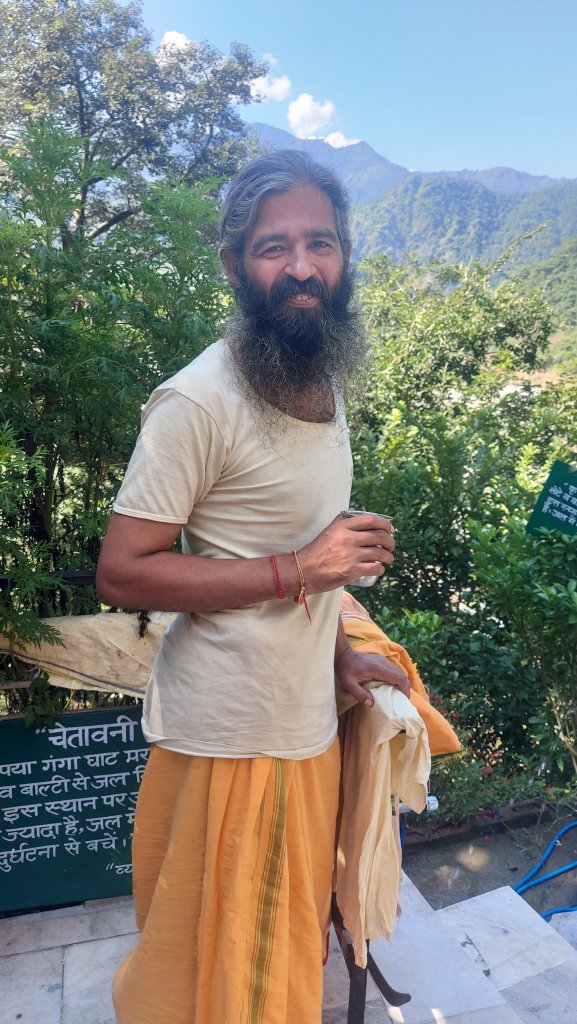
The pundit who expounded in Sanskrit on how powerful the Ganges is
The stoic mountains that surrounded us in Devprayag, overlooking the sacred meeting of the Ganges with the Alakhnanda and Bhagirati rivers
Me delighting in the tranquil and sacred vibes

The Ganges likes to be active. One felt a dancing, prancing vibe as she made her way around the stoic Himalayan range…undaunted by the monsoon mud coursing through her veins on her sparkling sojourn. She was so near and yet far…a constant vision in front of us at our Ganges By the Banyan Tree resort. Come tea time, and all of us aspiring Sufis, sworn into silence, would sit on plastic chairs and surrender to the vibrations of our sacred horizons..viewing the seductive Ganga, the changing yet unchanging hills and skies. There is a harmony in nature recognized by our very DNA. Tea drinking took on an inner dimension here as we synced ourselves to an uncomplicated Universe, designed to carry us with its intelligence through victory and valleys…if we only surrendered.

We also went for a dip into a beautific waterfall, a treat for city dwellers accustomed to little natural mystery. Here, it was our feet venturing over hidden pebbles, grounded into the present moment as we splashed and laughed. Even if we had been a group in silence, we became family as there were hands perpetually ready to reach out to steady us. Even in nature one learns to ‘connect’; certain rocks, we discovered, were trustworthy as they anchored us against the relentless pressure of the falling water. Our inner child took over and this was No Mind occurring most naturally!

The days were packed with intense sessions. We plunged into intense active meditations designed to expunge and unclog our Chakras. These meditations had been designed by mystics like Osho and Gurdjeff, to help a data-overloaded mind throw out all its baggage and for the mind-body system…particularly over-burdened hearts and throat Chakras.. to get detoxed. We got into Osho Gibberish meditations as well…as Gurdjeff the mystic found this process accelerated his disciples’ spiritual progress. It is a trick to get out of the mind by nonsensical communicaton, helping hidden emotions to surface without the filters of socially approved and understood language.

I later heard Meera talking about Gurdjeff’s extreme and almost nutty experiments with his disciples, “including getting them drunk..as under the influence of alcohol one’s true inner dialogue can be heard. After listening to a group of drunk disciples, he figured which ones are truly on the path and which weren’t and honed his followers down accordingly,” she shared, over one inadvertent tea time conversation (only she was permitted Indian chai and speech;)

We truly delighted in the Sufi whirling, with skirts and blouses especially stitched prior to the retreat with facilitation by the retreat team. While the skirts seem weightless when we watch Sufi whirling, in actuality they have a heavy border that provides ‘grounding’ for the dancer

In fact a covering message on our skirt packages read, WINGS TO THE BELOVED…The whirling skirt is an integral part of the whirling dance. It helps in grounding and centering. Traditionally the whirling skirt was made of the cloth used to cover dead bodies, signifying the death of the ego. It signifies the letting go of our false identity, so our pure, Godly nature shines forth.”

Even more interesting, the prayer that echoes in the heart ❤ of a Dervish is…”Empty me, my Lord! Empty me of myself so only You remain.Merge me in You.” A tag line went, Rahe-e-Ishq: THE Way of Divine Love!

Towards the last day of the intense retreat, we trekked to a river..a tributary of the muddy Ganges..for a redemptive swim. This truly proved to be the ice breaker we all needed, as we held on to a rope tied to a rock (so as not to be swept upstream)..and revelled in truly merging with clean water, clean air and bright blue sky. My sunglasses became a casualty, falling into the water and vanishing for an eternity!

Meera experimented with dipping her full head into the current to feel its power..and at one point as she floated with a life jacket, face looking skyward, a butterfly perched on the tip of her nose! To many this seemed like an ancestral spirit blessing our young master.

The grand finale was the Naamkaran ceremony, where those aspiring for a spiritual rebirth opted to get a new name. The care taken to elevate the hall where we conducted our daily activities, was palpable. Marigold flower arrangements were made all around, while intense dhoop and aggarbattis permeated the space, but the most transformative energy came from the music..sacred chants and bhajans rang out through large speakers, casting a celestial spell. All the participants were freshly showered and wore white, which enhanced the angelic vibe.
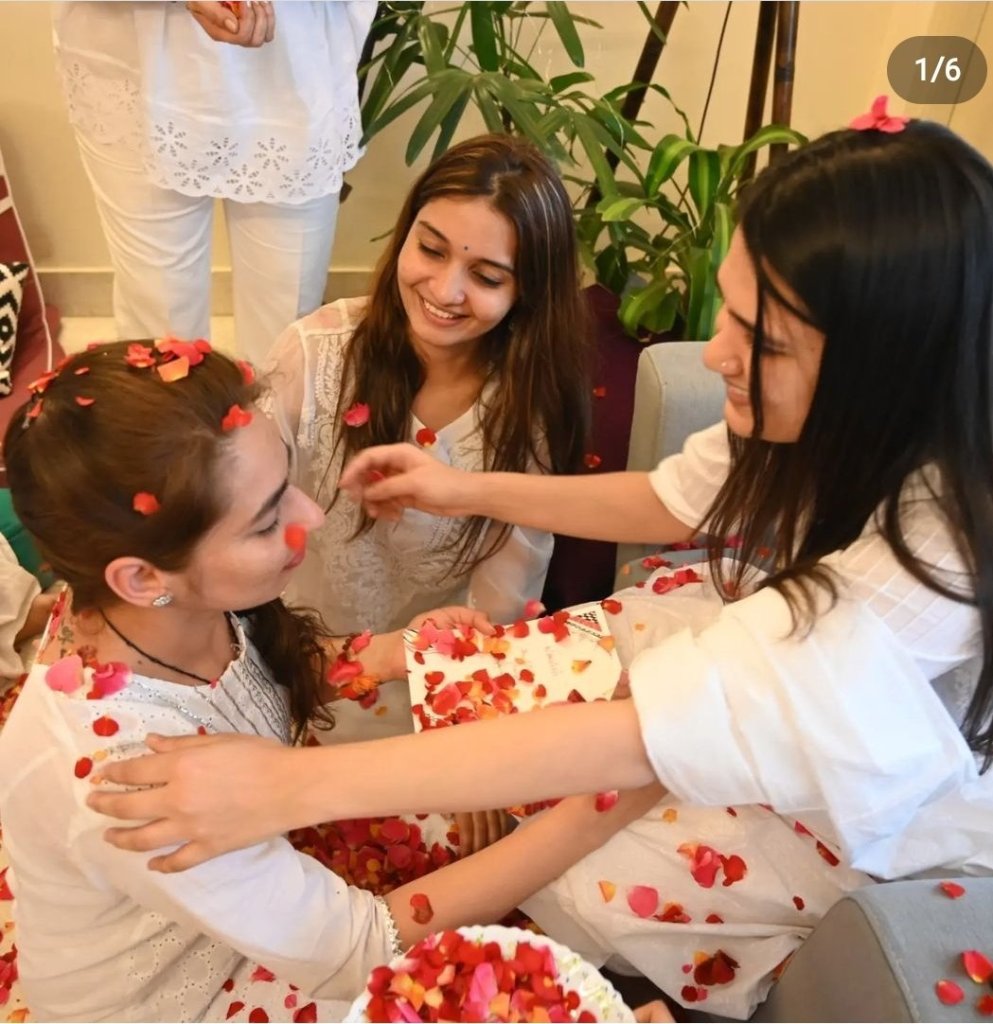
Calling one participant at a time, to her sanctum, Meera engaged in a deep energy dialogue with each soul trying to reboot ..looking deep into his or her eyes, while her team held, embraced and supported different chakras…particularly the heart Chakra. Many were moved to tears as this wordless dialogue carried on, soundlessly healing hidden wounds. Meera was a mere channel in this dialogue, something she confessed the next day. “I surrendered to my Father..he was doing everything…” She shared. But we all felt her generosity that night, as she too surrendered to the process that touched so many at such deep levels.

I was told no new name had yet arrived for me…but I did get that experience of being scanned by Meera’s eyes which seemed possessed of another light. A divine, compassionate, all-knowing light. I felt a redemption and I felt my heart melt…..it almost felt identical to how one melts before Shirdi Sai Baba’s presence in his sacred shrine.

We left Devprayag as a newly minted family, knowing that we had just surrendered to a different dimension of existence…one that was effortless, filled with little miracles and new possibilities.

Will we be able to sustain the Sufi Way of surrender, living in the innate abundance of the Divine Present Moment?
SWEET DREAMS ARE MADE OF THESE…

The dream is the liberation of the spirit from the pressure of external nature; a detachment of the soul from the fetters of matter.’ – Sigmund Freud

Now for centuries, the dreaming process has fascinated people.

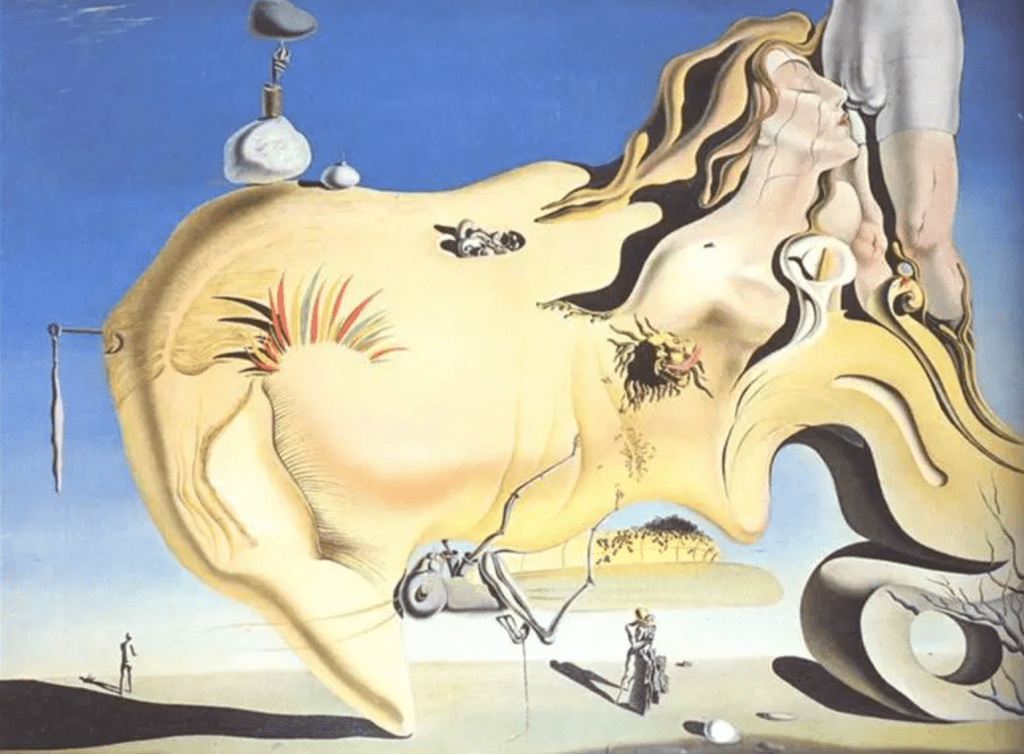
A mask of Spanish surrealist artist, Salvador Dali

How many times has one sensed that the time we spend sleeping, dreaming, is addressing our ‘waking’ time in a myriad ways that we have just never figured out? If the average night’s sleep is eight hours (one third of a day), one sleeps for one third of one’s life! If you live, say, 75 years, that’s 25 years asleep, or 9,125 days. Within those sleeping hours, we sit in the movie theatre of our subconscious mind. We live, as we dream… alone.

Entire schools of psychology like Freudianism, (a legacy of Sigmund Freud), emerged from his therapy sessions with clients, where he traced many issues like hysteria, neurosis, paralysis – to repressed memories and impulses, which often surfaced in dreams. Expressing these often led to ‘breakthroughs’ – a chance to be ‘free’ of psychosomatic pains and neuroses which was the body’s way of dealing with unprocessed impulses, desires, feelings.

Another famous psychotherapist, Carl Jung, believed that the human race had a ‘collective’ dream, rich with ‘archetypes’. He identified four main archetypes—the Persona, the Shadow, the Anima or Animus and the Self. To him, these lived as shared ancestral memories which also persist in our dreams, art, literature and religion. While you don’t have concrete scientific disciplines teaching courses in Dream Analysis, (which makes Nuzhat’s choice to be a Dream Coach even more brave), you do have clear movements in the arts, literature and cinema reflecting this fascination with dreams – Surrealism in literature, with authors like Salman Rushdie, Gabriel Garcia Marquez; Surrealism in art in the 1920s with Salvador Dali as its brightest exponent, and film directors also of the 20s who played with surrealist projections, like Louis Bunuel, Dali, David Lynch, Man Ray and Kunto Kato, among many others.

The Surrealist Movement liberated the Spanish performer, artist, film-maker Salvador Dali from ‘logical’ imagery, and the work above ranks among the 15 most renowned works by him

Now how much importance have you, dear reader, placed on your dreams?

MEETING NUZHAT JAHAN….A DREAM COACH!

Despite having a major in Literature and Psychology for my BA degree, I had been quite out of touch with the shamanic power of dreams, until I happened to meet the graceful Nuzhat Jahan at a tea-tasting. There was something Shazam-like about her belief in what the slippery world of dreams could do for you. I mean, this young lady had walked away from a highly pragmatic practice of 13 years as a corporate lawyer, to segue into a full-time practice as a Dream Coach!

With Nuzhat Jahan at the Kathiwada City House

Nuzhat has the confidence of a woman of global exposure, having grown up in the magical Fiji Islands (filled with the wonders of nature) and gone to high school and college in Auckland New Zealand, and then worked in London and Dubai. But Dreams as a vocation? C’mon, I can hear her pragmatic parents say, ‘This is an arena where you cannot even boast of blue-chip certification, to draw your initial clientele in!’  

However, she felt guided because, “About a decade ago, I started having dreams of revelations. I had this deep desire to understand the dream phenomena. The dream dictionary approach or googling dreams only touches the surface level. When people start tapping into the Dreamspace, their dreams become lucid and can be revelations of something that’s going to happen, either just around the corner or in future. My first book, Lahara, We Are One, is written based on the premise, ‘We all dream, therefore we are One!’

She started having a deep belief in how Dreams, if listened to, remembered, processed, were powerful tools of transformation, healing and guidance. In fact, she shared a fascinating story about how a dream guided her to Mumbai!

“I dreamt of a Sadhu sitting on a cot in a hut, and I was in that hut too. Now in my waking life, I am a Muslim with no daily connection with Sadhus or temples or Hindu tenets in anyway! I saw him pointing to the door as if to say, you need to step out into India. I took this dream as a very strong message that India is going to be an important part of my journey going forward,” she shared. “And here I am, in Mumbai!”

We had just finished experiencing a workshop on Dreaming, at culture and fashion doyenne Sangita Kathiwada’s the Kathiwada City House. As she opened the session, Nuzhat touched upon the many ‘functions’ served by dreams, how they represent a vast landscape of possibilities which often defy or challenge definition.

As the workshop unravelled, participants shared fascinating tales of recurring dreams at certain phases of their lives. Yours truly shared how a ‘haunted’ hotel room gave me amputation nightmares and when I woke up, all the lights in the room were going off and on in a furious, disruptive way – showing me how negative energies or disembodied souls can also play havoc with your subconscious mind. Sangita Kathiwada confessed she travelled with a salt lamp and rock salt, to diffuse negativity in any hotel room.  While many had trouble recollecting their dreams, Nuzhat shared how it would be wise to sow the intention of getting guided through a dream, and dream journaling so you ‘remember’ the narratives and what they may mean to you. “I have even had guidance on whether dating a particular person is right or wrong for me!” she laughed, narrating that dream.

REACHING OUT INTO THE ACADEMIC ‘GAP’ WHERE DREAMS GO

So sacred is sleep and dreaming to the mind-body system, that I even recall a pious Parsee lady in my building saying it is a ‘sin’ to rudely awaken a dreaming, sleeping person. Some people don’t put mirrors around their beds because they feel during astral travel, a soul arising from its host body may be ‘shocked’ at seeing its own soul reflection! Yet, there are other mundane-sounding theories that dreams are basically old ‘files’ being deleted to clear brain storage space for new data.   

But since the surrealist waves of the 1920s and 30s, which followed the work of dream-merchants like Freud and Dali, there does seem to be a gap, that the world of science and coaching has so little to offer by way of ‘dream’ studies and data around how dreams interact with our waking lives.

 “Yes, there is this institute in Canada that does teach about dream archetypes and what they mean. I am sure there are many small schools like that, but no mainstream holistic course on Dream Interpretation. It’s possibly because it’s open to a subjective understanding of dream narratives. I may have looked up a host of dream symbols, but it doesn’t make me the expert dream interpreter. However, tapping into intuition, looking into a person’s life context, I can guide someone on how to analyse and understand the messages of their own dreams and what it could mean to them.”

Keeping her lawyer cap on, Nuzhat has researched dreams through different filters – psychological, cultural perspectives, religious perspectives. “By doing that, looking at religious perspectives, I noticed we are actually One. That all religions have decoded dreams through the ages as well. Remember how the famous French writer and philosopher Rene Descartes said, “I think, therefore I am.”  Dreaming is universal and archetypal.

A CLEAR CATEGORIZATION OF DREAMS

“A person’s identity and belief system have an impact on the dream symbolisms, and the narrative that’s played out by one’s psyche. Firstly, dreams can be categorized as dreams from the Self. That is what we desire and want, can surface up. These dreams are as important as it can tell a lot about the self. Understanding ourselves better is a key ingredient to then tapping into our dreams to help us navigate our lives better. The Second type of dreams are scary, such as nightmares or sleep paralysis. These dreams can sometimes surface when one is going through a stressful period or a transition. However, traumatic dreams such as these can be harmful if they continue for periods of time. Leaving one feeling negative or fatigued. The third type of dreams are revelations or premonitions. This is time travelling into the future. Dreams of revelations are things you see as is, and they are manifested in real life very soon, such as dreaming of a person and then meeting that person. Dreams of premonitions are more symbolic in nature and require decoding. These dreams take longer to be manifested in reality. The Fourth type of dreams are a special category. Which is astral travel into space, outer body experiences, or time travelling into a past life. I don’t openly discuss these dreams, because they are very spiritual in nature. Unless someone has experienced it, then we discuss its understanding in private. The fifth type of dream can help everyday people with better work productivity and inspiration. Becoming intentional about dreams, such as speaking about dreams and keeping a dream journal can help in better remembering of dreams. The inspiration or ideas of how to solve a life’s problem could be shown in a dream. Or one can induce lucid dreaming to tap into their creative project to see things from a bird eye’s perspective to come up with better ideas,” she shares.

NINE GREAT INVENTIONS BORN IN DREAMS!

For those of us who have long underestimated the power of dreams, and sit staring at the idiot box cutting back on sleep, here are some true life stories of game-changing inventions that took birth in people’s subconscious inner movies!

1.     GOOGLE  As a student, Larry Page had an irrational fear that he’d been accepted into Stamford University by mistake – which trigged an anxiety dream. He imagined that he could download the entire web onto some old computers lying around, so he got up in the middle of the night to do some maths. When he realised it was plausible, he took two years out of studying to create what became Google. Imagine how different your daily life, indeed the modern world, would be if he hadn’t had that dream.

2.     THE SEWING MACHINE A violent muder nightmare led to the humble sewing machine. In 1845, Elias Howe dreamt that he’d been captured by cannibals who gave him an ultimatum – he had to invent a sewing machine within 24 hours or suffer a painful death. He failed, so they stabbed him to repeatedly with spears that had a hole in the tip. Howe realised that he had to put an eye in the needle to create the lock-stiche sewing machine he’d always struggled to invent.

3.     DNA Until Dr James Watson saw a spiral staircase in a dream in 1953, no one had developed the idea of a double helix spiral structure for our DNA. In fact, thanks to sleeping that fateful night, Watson went on to win the Nobel Prize in Physiology or Medicine in 1962.

4.     EINSTEIN’S THEORY OF RELATIVITY One of history’s most famous physicists, Albert Einstien dreamt that he was walking through a farm where he found a herd of cows huddled up against an electric fence. When the farmer suddenly switched the electric fence on, he saw the cows jump back at the same time – although the farmer saw them jump one by one in a Mexican wave. That’s what inspired Einstein’s Theory of Relativity – that events look different depending on where you’re standing, because of the time it takes the light to reach your eyes.

5.     FRANKENSTEIN In the summer of 1816, teenager Mary Shelly visited the poet Lord Byron in Geneva. One night, she had a nightmare of a ‘hideous phantasm of a man, stretched out, and then, on working of some powerful machine, show signs of life and stir with an uneasy, half vital motion’. The next morning, she began writing the story you know as Frankenstien – the world’s first sci-fi novel. Thanks to that dream, she became one of the most famous gothic writers of all time.

6. THE PERIODIC TABLE Pioneering chemist Dimitry Mendeleev spent 10 years trying to create a pattern that connected the chemical elements together. One Februrary night, just as he was on the verge of a major breakthrough, he fell asleep and dreamt up the idea he’d been searching for. Writing in his diary, Mendeleev said, “I saw in a dream a table where all the elements fell into place as required. Awakening, I immediately wrote it down on a piece of paper.”

7. THE STRUCTURE OF THE ATOM In a dream, Niels Boher saw the nucleus of the atom with electrons spinning around it – like planets going around the sun. He had a gut feeling that it was accurate, so dedicate his research to proving his theory. Low and behold, he was spot on and won the Nobel Prize for Physics for his breakthrough.

8. SALVADOR DALI’S PERSISTANCE OF MEMORY The surrealist master Salvador Dali described his paintings as ‘hand-painted dream photographs’, including his most famous piece ‘Persistence of Memory’ full of melted clocks. It’s one thing to invent whole world’s in your sleep, but quite another to capture them on the canvas. 

9.     THE TERMINATOR Yes, one of the most successful films in history was inspired by a fever dream. Director James Cameron imagined an explosion, and coming out of it was a robot cut in half, clutching kitchen knives and crawling towards him. He sketched ‘The Terminator’ down when he woke up, and ultimately, actor Arnold Schwarzenegger made the character his own. Think this all sounds a little far-fetched? Remember, dreams organise and consolidate ideas, images, memories and bits of information that you gather up when you’re awake throughout the day. Letting your mind wander during sleep can lead to greater creativity.

(Source: https://www.bedguru.co.uk/9-inventions-inspired-by-dreams)

MENTAL HEALTH INTERVENTIONS WITH DREAM INTERPRETATION

Given the Pandemic pushed a lot of people out of their comfort zones – tearing them away from many aspects of their lifestyles that they had never questioned, a quiet, often undetected mental stress peaked, when they saw how unfulfilled they really were. How did working with dreams help such individuals?  Says Nuzhat, “Well I had a client – a young sportsperson, who was really good looking, in his 30s. He earned well, had a celebrity status, was always dating supermodels. he truly had it all. Yet he felt very unfulfilled, he was going from one girlfriend to another, and feeling down and depressed. He felt a lack of purpose and direction. So I asked him about his dreams, and we found he was having very superficial dreams… like “the next best things, the next best car, supermodel.” So I asked him, what do you feel these dreams have to say about yourself and your life? And he said, ‘it seems like these are the things I am desiring.” So we found that even having all this, would have left him feeling empty. So I told him this was “destination chasing,” and such goals would only grow the pursuit of more and more. So soon after, he met someone through work, but she wasn’t the typical trophy girlfriend. She was a nice, real person and he decided to commit to a real relationship with her. And over time, his materialistic dreams changed… because his relationship was giving him interpersonal joy in simple things like cooking together, sharing experiences,” she shares.

“The subconscious is very clever; it has a beautiful way of communicating with us. If you are not listening in to your dreams, you are possibly missing out on stories with layers of messages for you…” shares Nuzhat Jahan

DREAMS CAN UNLOCK SITUATIONS AND EMPOWER US WITH PRESCIENCE

Although confidentiality for her high profile clientele is a key tenet, there are some stories Nuzhat is willing to share, where decoding a dream created a landmark difference in clients’ emotional life and even financial life.

“There was this lady from Turkey, who reached out to me – she had read my book, and she was like “Please interpret my dream.” Her mother had appeared in her dream – she had passed away, and the dream was taking place in a mosque and she got pricked by a needle, and then there was blood. The mother then gave her two guavas. That was her dream, and she was keen for an interpretation.  So I asked, is your mother alive or dead, and she said, “dead”. I asked do you have any children, she had ‘one child’. So then I asked, “did you suffer a miscarriage?” And she said, “Yes, I have been grieving that, and afterwards I had this dream!” So I said, “Then rest assured, have comfort that you will have another child, you will have two children. Those two guavas you saw represent two children. This was my intuition. Years later she was like “thank you so much for comforting me, and I do have two kids.”

She also recalls another case, where “A friend’s father had a dream where he saw himself digging around their office space, and then seeing snakes and then seeing a treasure box. So I sort of said, “there is untapped potential in the family business and there are some barriers and some blocks that need to be removed before you can tap into it.” And later on, they discovered there were some issues with their financial spreadsheets, where someone on the inside was stealing money and trying to keep them away from their untapped potential. So it was, when they located and removed those snakes, that the family business rose to even greater heights. And it was a recurring dream. Had they not tried to understand the dream, they would have not have such positive, business-transforming outcomes!”

It’s time to switch off that late night Netflix binge-watching and tune into the ‘inner content’ that can change the course of your journey for the better!

Remember those famous words by Langston Hughes:

“Hold fast to dreams,
For if dreams die
Life is a broken-winged bird,
That cannot fly.”

THE RACE COCKTAIL & BRIDGERTON SEASON TWO

INDO-BRITISH LOVE STORIES ABOUND IN HISTORY, BUT IN THIS NEW SEASON OF BRIDGERTON THE CASTING OF INDIAN WOMEN IS MISLEADING AS THEY ARE BRITISH IN EVERY DIMENSION..THOUGHT, MANNER, ACCENT…WITH THE EXCEPTION OF ONE SISTER CALLING THE ELDER ONE ‘DIDI’ AND OTHER INCONSISTENT TOKENISMS IN SPEECH. THEIR STYLING AND MAKE-UP HAVE BEEN CALLED ‘APALLING’ ON SOCIAL MEDIA. SANGEETA WADDHWANI REVIEWS ROUND 2 OF THE MATING SEASON DRAMA

THE LOVE TRIANGLE…BRIDGERTON 9 2

If season one of Bridgerton introduced us to a very Austenian Brit storytelling style with the socially correct deliberations of 18th century British manners, with the hottest pop tracks of the day playing out as ballroom dance orchestra music…the cherry on the cake was pairing up Daphne Bridgerton (the Diamond debutante of last season) with the rakish but charming Duke of Hastings, Simon. It was a gamble twisting around the historic race divide but the chemistry between the two lead actors..Rege Jean-Page (Simon Basset, the Duke) and Daphne (played by Phoebe Dynevor) virtually exploded through the tube!

She was a dainty, vestal looking Caucasian actress and he is born to a Zimbabwean mother and a British father. Yet the racial diversity…with an African Queen..only seemed to make the Daphne- Simon coupling more interesting and he seemed -with his haunting backstory and resistance to commitment- far more exciting than her other pale and insipid suitors.

Season 2 of Bridgerton however, focuses on another Bridgerton’s marital prospects – Daphne’s brother Anthony, the highly eligible Viscount. AND VOILA! Who are the prime female eligibles for him? Two Sharma girls from India!

Now in reality, the actors are Indians of British citizenship. Charithra Chandan plays the younger Sharma sister, Edwina, while Simone Ashley plays Kate, the toughened sophisticate. With luck, the Queen declares Edwina to be the Diamond of the Season. Hmmmmm…this brings Edwina into the radar of the tall, majestically handsome and pragmatic Anthony Bridgerton.

Kate the elder sister takes an instant dislike towards Anthony, having overheard him say typical male chauvinist things about marriage and wives in a man talk session not meant for her ears. She repeatedly warns her debutante sister Edwina, that Anthony is a terrible candidate for husbandhood.

And so the season unfolds…

But somehow, the casting of this round feels a little off point. Edwina has a diabetes-inducing sugary temperament, is way too short to realistically even twirl in the ballroom with the lofty Viscount, and to me, is not even styled in colours that enhance her dark, chocolate skin tones. She has beautiful features and a pleasing voice, but that lack of height sadly diminishes her presence. Certainly not Diamond material. Perhaps they could have come casting for Edwina in the corridors of Indian theatre and TV…even wannabe Ms Indias could have thrown up more statuesque lasses in the first bloom of womanhood.

Kate Sharma and Anthony Bridgerton…a forced spark…lighten up my lady!

Edwina’s taller and sturdier sister, Kate, seems to be a better casting choice but one sees too much darkness in her nature, as if she were a fixed, obstinate and downright offending creature, living too much in the head and too little in body.. in a way that feels monotonous and lacking in the Eastern seduction. At least in the early episodes. Both Anthony and Kate are initially unaware of their attraction to one another but even when it does unfold ( leading to the love triangle KJo would be proud of…)…it feels like two rather alpha masculine beings are trying to be soulmates. Kate is rarely ever prettified, vulnerable, feminine..

By comparison, Daphne and Simon had that masculine-feminine polarity in all pristine glory. Also the cooking of that chemistry was slow and devilish, filled with hints of potential fireworks. In this season, in Anthony’s place, most men I reckon would leave well alone a woman like Kate, who ostensibly chooses her freedom over the prospect of life partnership…but is contriving enough to engineer her sister’s path to wifehood to secure an inheritance that would take care of all her spinster years… in financial terms.

Both the Sharma girls could have been less British in tone and been shown to be at a little cultural variance, to acquire deeper dimensions of character…although as the story acquires more depth we see a haldi uptan for Edwina on the eve of her marriage. Also a nice sentimental twist when Edwina places their late mother’s bangles on Kate’s wrists..and it is the accidental tumbling of a bangle that reveals the intensity of Anthony’s focus on the elder Sharma at the precise moment he and Edwina are about to take their vows on the altar. Whew! The way a family ghost can reside in an heirloom to bring in justice!

Viewers have been hugely disappointed with this season’s tokenisms and the rather unflattering representation of Indian charms. Shobhaa De has posted, “What on earth is this? Desi viewers saying Bridgerton is a lousy joke with the worst make-up, hair, costumes and styling. How did those smart folks go soooooo wrong?” (@shobhaade on instagram).

And some of her responders make truly valid points…like @anjula.m12 who points out, “The representation is so confusing. The Sharma sisters have features from Southern India, call their father Appa, the younger sister Edwina is referred to as ‘bon’, (which is sister in Bengali), they speak Marathi and Hindustani, have fluent British accents, and they play marauli (what’s that?)….Make-up and wardrobe too wierd. Yet good to see the diversity,” she says. Am not so sure the ‘diversity’ did justice to Indian female charms, is my only point. I appreciate all her other observations.

For the most part, we truly miss the magic of the Duke of Hastings and Daphne…there was a rebelliousness and struggle for their coupling too…and it is a pity that Rege Jean-Page is no more a part of the webseries. There are nice curveballs worked into this season..like how the Sharmas are undone by the wagging of a tasteless and materialistic aunt who knows that if Edwina and Anthony do wed…the Indian girls will get their due inheritance. She doesn’t clearly care for that to happen…And also the revelation of the true identity of Lady Whistledown. That is a truly suspenseful thread woven to reveal that Penelope is a businesswoman at heart and a Feminist who leans on her powers as a scandalsheet doyenne…and even when she has to take extreme steps to remove Elouise from the Queen’s suspicion, and she virtually stops writing…the pen snaps back into action when her heart is once again injured by a young man.

But all in all if Bridgerton season one was addictive, season 2 did seem a bit of a forced cross racial love story. Perhaps because one has seen at Indo Brit events, the English keeping to their tribe unless there are Indians who can adopt to their manners of speech and dress. Sure there were Indo Brit alliances but many of them were about the British becoming Indophiles and being turned on by the bare bellied bosomy Indian women who floated around them….as housemaids, nautch girls, governesses, mistresses, even artists’ muses.

Howevet, after sitting through the entire season, one is relieved to see that what initially felt contrived does acquire richer nuances. That cultural contrast is not such a contrast after all. Both Anthony and Kate have had to lead their families in lieu of their fathers being no more…and had learned to stop listening to their hearts. Just this psychological thread binds them together fairly adequately.

Kate’s character may have become more calloused than her sister’s because she was trying to make the right sacrifices…but when that veneer wears off, we do see a Kate with feelings unraveling. Some softness does enter her gaze in scenes where she learns of Anthony’s personal tragedy…and still, there is a typically Indian sense of stoic sacrifice for Edwina’s happiness even when Anthony declares his infatuation for her. This is very Indian, very soap opera ‘Didi.’ What we call in good Bombaiya terms, Emotional Attyaachaar.

It’s quite amazing how two strong individuals bearing a similar inner blueprint can be drawn to each other even when every other consideration could keep them apart. Towards the end, one is able to empathise far more with the distinct nature’s of the Sharma sisters…even the sugary Edwina proves her mettle when she does a U-turn on Anthony — at the altar mind you — and clears the space for Kate to act on her true feelings.

Now, what do Bridgerton fans feel? One fan responded to me by saying Jonathan Bailey (who plays Anthony) is gay. In that case, the passionate moments he manages to bring to his scenes with Simone (Kate) are praiseworthy! I too started feeling a genuine spark between the two.

Would love to hear your views!

A DEEP DIVE INTO AN ALTERNATIVE REALITY: THE MALDIVES

SANGEETA WADDHWANI TAKES A LEAP OF FAITH SIGNING UP FOR AN ALL-GIRLS TRIP TO THIS NATURAL PARADISE FOR A SPECIAL DATE…A BIRTHDAY AND HOLI…ONLY TO DISCOVER THAT EVERYDAY IS A CELEBRATION HERE!

The White Night at Kaani Palm Beach resort…

They say life happens when you are busy making plans. I say that’s bs*! Life happens when you DO make plans! Or perhaps life is at its best when your daydreams align with manifest opportunities…

Like many out there who felt a sense of FOMO looking at posts from celebrities at the Maldives during the initial lockdowns of 2020, I too started wishing to ‘manifest’ a Maldivian holiday. There had been many a reason to escape the drudgery of the last two years. Plus, while my erstwhile HELLO! team had done some fabulous cover story shoots there, I as a writer was never a part of them. Somehow budgets were restricted and I would in good faith do phone interviews with the star post shoot. But once the pictures came in…it literally felt like the team had been to “Para, Para, Paradise” (Coldplay melody!)

To cut to the chase, browsing through Instagram, I saw an ad for an all-inclusive, all-girls package tour to Heaven-On-Earth. It included flights, resort stay, most meals, and super exciting experiences like snorkeling, swimming with sharks, dolphin spotting, beach picnics, with optional experiences like Para Sailing, Tube Boating, Jet Sking, etc. As my Content Shop, San Creatives, was off to a rocking start…AND I do believe March 17 this year was so many things…Holi, Satya Narayan Pooja, St Patrick’s Day….I opted for the trip going from March 17 to March 21.

Boy did it galvanize my mental, physical and emotional states into a world filled with beauty! And being an all-woman ensemble (spunky and fiesty girls who had traversed many life experiences)…the collective energy was sparkling! Every time our speedboat hit a big bump on the high seas…we collectively yelled and laughed…and all our city bred manners were literally gone with the wind!

For me personally, traveling to a destination solo to team up with new co-travellers, had happened before. Like when I did the Jewels Of Italy tour…and met people largely from the US. But that was an older…almost retired demographic. So what really worked was the experience of seeing the epic Vatican City, the Sisteenth Chapel, Florence’s legendary museums with its David statue…grabbing Gelato at the Trevis Fountain and sampling blue champagnes in Tuscany.

Italy was about history, art, sculpture, jewels..a sense of surrealism in the watery bylanes of Venice…and awe-inspiring jokes by our sing song Italian guides, who referred to me as “San Cheeta the Celebreeety” because I was always five minutes late reporting back to the bus:)

IN MERMAID MODE

The Maldives brought us fathomless water bodies dressed in their winking, dancing, seductive best. Everywhere we looked, we were hypnotized by arresting shades of aqua, aquamarine, turquoise and sky blues, playing out like a perpetual palette waiting for a paintbrush to dip in. Only in this case, we became the brushes that dove in!

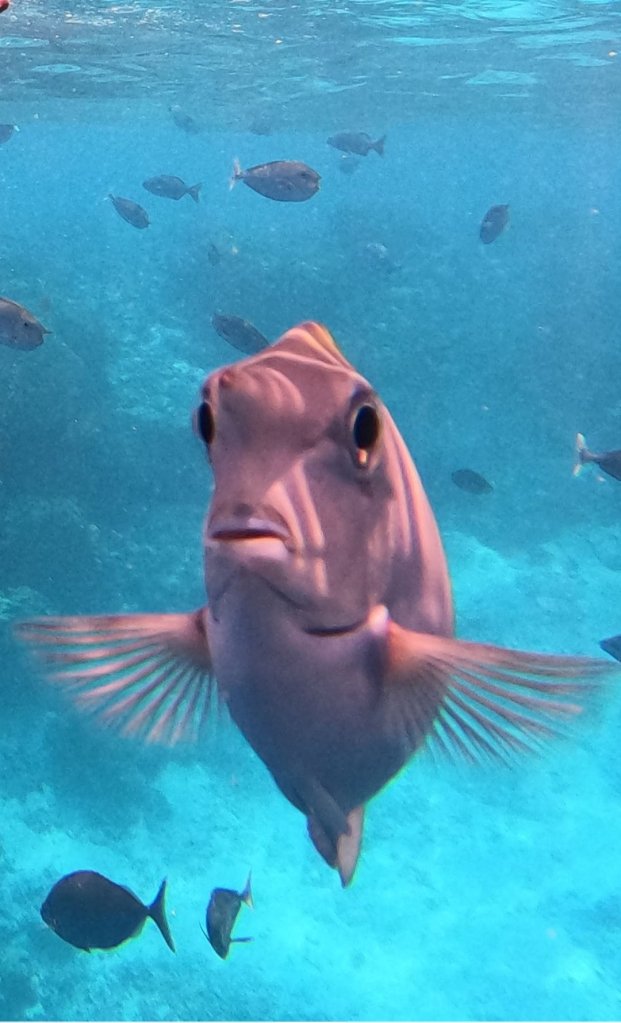
What a world we witnessed down there! I was the first to get into mermaid mode, with my snorkeling skills in place from a previous experience in Lakshwadeep. I felt a strange sense of peace envelop me in sea consciousness…fishes moving in a carefree dance, going everywhere and nowhere. Such an abundance of sea life, coral reefs…a symphony that one easily becomes a part of…and lo! Once the pictures of my experience emerged, it actually looked like I had found a piscean soulmate in a Nemo lookalike:) He looked happiest besides me and saddest when I waved a goodbye!

Me in a different ‘Underworld’!

That is the beauty of stepping beyond the urban comfort zone. One is always humbled by the infinite forms of life we share our planet with…and more humbled when realizing how we have dumped all the waste of our civilization into the legitimate home of our sea life. The Pandemic showed us a reverse colonization.. where creatures of nature asserted their spaces in our concrete jungles. What a powerful reminder that we are flatmates checkmating our own habitats…!

WHAT IS THE MALDIVIAN MYTH?

The Maldivian seas MUST have some mystical, mythical history, I felt. There is an ancient tendency in India to associate rivers with goddesses…and the Narmada is said to be dauntless and most alluring, while the Ganges is adored for her pure spiritual lineage…pouring down from the heavens and through the matted locks of Lord Shiva.The oceans here must have a panoramic oceanic deity, because the native people who worked around her waters had a stoic dignity and simplicity all at once. We called them our Chocolate Boys, as they were universally dark skinned with delicate features and light, water friendly buoyant bodies. Our speedboat driver, Hafeez, looked like a replica of Lord Shiva…and by faith he was Muslim! Another man called Suja who tirelessly captured our underwater shenanigans had every mannerism of a Jim Sarbh…and one of the ladies openly admitted to a crush on him!

Hafeez, our speedboat driver and all purpose support onboard, resembled a Lord Shiva prototype!

A SEA CHANGE

The Maldives, comprising of about 1200 islands, let’s not forget, are framed by The INDIAN Ocean…beguiling, pure, rich in sea life. Our cities..including Goa…have the ARABIAN Sea all around…the difference in colour and character between the two seas, feels like the difference between a black and white cinematic experience vs living in a technicoloured universe. I remember an expat at a party in Mumbai once sharing with me that although “Mumbai is surrounded by the sea, one doesn’t feel the sea or sense it much.” I reckon it is because our Arabian Sea just has a hint of blue in the winter…and looks like a dowager in 50 Shades of Grey most of the year, merging perfectly well into our concrete setting. Grey sea, Grey skies, Grey buildings, Grey streets. Also most big cities push the sea further away with reclamation projects…until you see more concrete than sea.

By contrast we learned that almost 600 to 700 islands in the Maldives are abandoned and totally uninhabited. We even had a lunch picnic on one of them, the shores and beaches were entirely ours to play with!

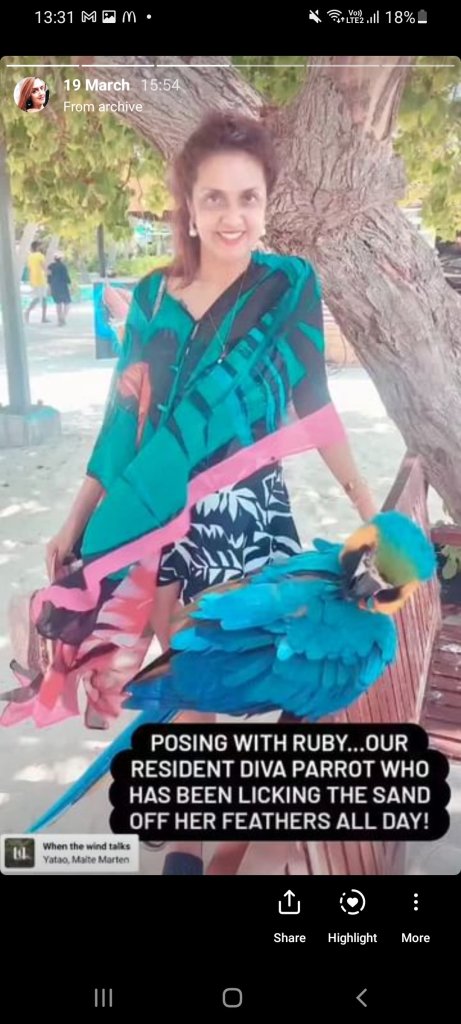
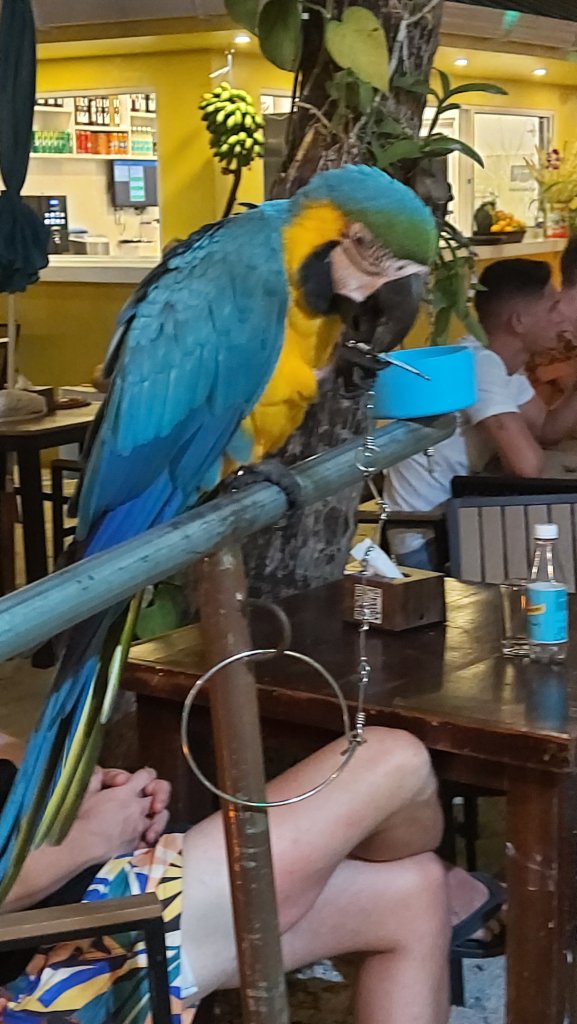
The other islands are moderately inhabited….while Maafushi where we stayed, was fully developed as a resort and tourist town. And what I truly felt happy about was that everything was a walking distance from our hotel…cafés, restaurants, watersports vendors, souvenir shops, juice bars. We even had resident South African ‘pet’ parrots fluttering around and preening themselves all day, and then sleeping perched at various non alcoholic beverage bars at night!

It does seem ironic that a paradise would consider alcohol illegal…but it is a Muslim country, and as one bar tender explained, “we can arrange for tourists, no problem but for residents it can lead to police arrests!”

We were also told that swimwear should ideally be conservative..but at Kaani Palm Beach all was ok, as we were located next to the Bikini Beach! What a luxury!

What I loved was the natural affinity with Indians and India, among the local people we met. Michael, who helped us with our group activities, was a Tamilian originally from Chennai. He had worked at a Taj property in Chennai before his former boss moved to the Kaani Palm Beach resort, taking him along. Another guide, Kaasun was from Sri Lanka. In most of the shops, the moment they saw Indian faces, they came down on prices, as if in homage to India! And later, at the Floating Bar, my Sri Lankan friend Kasun confessed of ” loving Bollywood music, Indian food and India!”

So one really felt at home, as many of the Chocolate Boys even understood Hindi! On our speedboat, they blasted Indian pop hits like Aaj Blue Hai Paani Paani…or soul stirring ballads from a host of Indian artists.

When looking back, I feel a particular sense of gratitude to my new friend, Sneh Tom hanker Doomray, who saw that no bday cake was available on order, and so created a cake from an assembly of dessert slices of ginger cake, painting a Happy Birthday in the Maldives message on a dinner plate…and getting a proper cake cutting ceremony in place! We later even managed a night of hookahs and storytelling at the nearby Moonlit bar, and another night of wild dancing onboard the Floating Bar.

We have sleeping dreams and waking dreams, luminous oceans and heaving grey seas…when we landed back in the bay, it was as if forced to wake up from a surreal reverie filled with nature at her prettiest. But once we got over the colour-shock and adjusted to this world, I learned to appreciate that cities are vibrant and have another raison d’etre. People…good, bad, ugly. I told myself that the Bollywood music danced to all over the UAE, Asia…was born here. Lots was happening and will continue to happen in maximum city.

But the Maldives islands? They offer fresh ink to the writer, fresh colours to the artist, and new meditations to lovers of nature. The islands took me to childhood fairytales and taught me to redream old dreams where one would draw a house, a beach, a nuclear family, a sky….and then swallow some clouds!

The Maldives remind us that Heaven is under our feet, as well as over our heads. It reminds us that the earth loves to feel your bare feet and her winds love to play with your hair…

VID_22140521_032216_796.mp4

DEEP DIVE INTO AN ALTERNATIVE REALITY:THE MALDIVES

THE JAIPUR JAMBOREE RETURNS!

AUTHOR AND BLOGGER SANGEETA WADDHWANI BRINGS YOU A RINGSIDE VIEW OF THIS YEAR’S HYBRID  JAIPUR LITERATURE FESTIVAL, WHICH BECAME A SPRING LITERARY SOLSTICE OF SORTS, SHOWING US A WARM CITY BLUSHING WITH HER FLORAL BLOOMS. ONCE AGAIN  THE HALLS RANG WITH VOICES ON WAR AND PEACE, HISTORICAL WOUNDS AND DISRUPTIVE FUTURES

Colours, voices, handicrafts, laughter, applause and the signature JLF melody swarmed around as one entered Clark’s Amer for JLF 2022.. so what if the winter muses were not with us…after a hiatus of two years, it truly felt like a homecoming!

The 15th annual Jaipur Literature Festival opened on a note of luxury mixed with heritage, as it relocated to the lavish spaces around this hotel… a hop away from the Jaipur International Airport. Formerly, we only ever came here at night, to listen to an eclectic menu of bands at the Music Stage.

Lit Fests create a sense of family, as one earnest acolyte (my young friend Siddharth Kothari) who has been collecting author autographs and their contact information for two years, put it to me… and I totally concurred. Subconsciously, I had been yearning for two years for the JLF experience… to see a familiar face, have a fan moment, taste the local kachoris and dissolve into laughter at a witticism… preferably a Shashi Tharoor one!:)

There is a certain awakening of the collective consciousness at a great gathering of minds, where the burning issues of the moment are tossed on the fiery wok of opinions, insights, updates and multifarious perspectives ringing in from around the globe. I remember so often attending my first sessions at JLF in a state of jet-lag, as only 5.40am flights took off from Mumbai. Still, I would imagine toothpicks between my eyelids as I listened to Germaine Greer talk of the loopholes in the Bill Gates Foundation’s methodology of distributing condoms in red light districts…as her grassroots exposure showed that those condoms were not really being used by ‘customers.’  All those billions assigned to control the spread of AIDS… it was philantrophy in atrophy!

Discussions like these produced so many reality checks, that I always saw the Jaipur Literature Festival as a Global Open University of sorts. And a Fifth Estate of Democracy as it were – a platform for free expression, where every disturbing trend… from the fading out of print media, to a lack of tolerance for dissent in the Indian Parliament in recent times, to the shredding of preconcieved notions of history, geopolitics, racial and gender faultlines, came into laser focus, so that new insights and solutions might be born.  One of the most powerful sessions I attended this year, touched on the sensitive topic of India’s neutral stance in the Russia-Ukraine war, called The Changing Axis: India, South Asia and the World. The voice of Bruno Maces sounded like a modern Cassandra, as he warned, “India will sooner or later have to become an ally to the US. Russia is fighting a lone battle, and may reach a point where they can no longer manufacture weapons if their generators are attacked. They will be a global pariah and India will have nothing to gain, and everything to lose, if she still stands on neutral ground.”

From conversations to books; one would think  this 1,000 year-old medium of storytelling, has taken a serious bashing in the metaverse-infused reality we live in.  The Jaipur Literature Festival however, (even while it had Twitterverse contests earlier)  continues to champion a commodity that catered to pre-internet attention spans…. and to be honest, books will always be sacred to born communicators.  Even when they sit stocked up like dinosaur eggs next to one’s bedside, hoping to crack open and impregnate the mind of their owner!

What about e-books and audio books? They may be relevant outside a lit fest… but when at JLF… you are urged to run to the bookstore and grab your copy, queue up and meet the author for an autograph!  This is the joy of an offline format. We have this quote from a Times of India article of a JLF attendee back in 2012, sharing, “The fact that you get to meet the author in person and get books signed is fascinating and that can never happen with e-books. I met Fatima Bhutto which for me is an opportunity of a lifetime and I will remember the interaction with her all my life,” said Payal Bhalla, who came from Chandigarh to attend the festival.  Ditto my experience meeting a publishing legend, global President of Conde Nast, Nicholas Coleridge, who signed his glossy gold-jacketed biography, appropriately called The Glossy Years, making me smile when he wrote, “To a fellow magazine person” in my copy! This was in 2020, just before the Pandemic put a pause to lit fests.

There was a time the statistics for book sales at JLF were staggering: Individual authors sometimes sold 300 copies at a time, and where international authors went… books vanished off the shelves before many attendees could even see them! This is precisely why… JLF brings authors to life in a way that is almost intoxicating, so one forgets that one has little time to consume more content than the phone-delivered gigabytes in a day.

Another argument for an on-ground experience is, the response of a live audience itself can elevate your session, just like musicians thrive on live feedback in a concert. Back in 2009, audiences numbered about 1,000. By 2012, the entire city seemed to have lined up outside Diggi Palace to see Barkha Dutt talk to Oprah Winfrey! It was almost dangerous, the kind of stampede that could have happened as the festival didn’t filter out students or charge them… but every time the audience reacted, electrifying moments happened. Getting a mike to ask a question was a luck by chance thing too!

One has seen JLF go from infancy to adolesence, to full blown adulthood (possibly in that epic year 2012, where we saw luminaries like Ben Okri, Deepak Chopra, Oprah Winfrey and so many other global influencers take the stage). Then while this galloping trajectory only grew, with many Alice-in-wonderland offshoots like heritage nights, the music stage (which had such eclectic fare like Sufi pirs who came in from Pakistan and sang without microphones, or Faiz Ahmed Faiz and Kaifi Azmi’s poems performed by his daughter Shabana Azmi, or performances connected to William Dalyrmple’s book on the sacred performing arts of India, (called Nine Lives)… the Jaipur Literature Festival was such a holistic experience, it came to be called the Woodstock or the Kumbh of literature festivals.

But then, like a villain in a B-grade plot, you suddenly had the Gigantic Reset. The Pandemic. And all offline engagement became like the Original Sin. The fabric of word, conversation, debate, dialogue-baazi – were sucked into the vortex called Zoom. Or Clubhouse. The annual JLF jamboree adapted beautifully, and went on to touch 27 million literature lovers worldover in 2020-2021 – but the soul of a lit fest was missing. The thrill of rubbing shoulders with a Jeet Thayil, a Kiran Desai… of chatting with a passionate interpreter of classical dance like Sharon Lowen… of telling Chitra Banerjee Divakaruni that her book Mistress of Spices, made Indian spices volatile and sexy…. the MetaVerse did not make such informal interactions possible. And yet, it did make it possible to avoid unwieldy lines, stampedes and the stress of not finding a place to sit, stand or hyperventilate in a crowded session. (Yours truly hung from a tree trying to watch Barkha and Oprah!:)

This year’s JLF fell in line with Covid protocol, moving into a larger venue like Clarks Amer, and those student crowds were gone. There was an intimacy one had not felt in recent years, which made asking questions during sessions a breeze. Sure one missed the Greek, American, British, Armenian, Czech, Middle Eastern voices – that brilliant global presence which made a trek to Jaipur feel like you were going around the world, in a literary capacity, in four or five days. But as one of the Festival Directors William Dalyrmple said in an interview to ANI in the pressroom, which I overheard, “JLF 2022 has been a real deep dive into Indian history and culture.” The Scottish writer-historian, shared that they had four Nobel prize winners in this year’s line up, and ushered in Booker Prize winner Damon Galgut, Baillie Gifford, Patrick Radden Keefe and Sahitya Akademi Award winner Namita Gokhale, who is also a co-director of the festival. 

I did savour a voice from Lebanon,  Katherine Pangonis, author of the book, The Queens of Jerusalem. Who would have ever known the Middle Eastern women rose to formidable power during the Crusades, and some even chose not to marry so they would not loose their autonomy?   The author was at pains to point out that most historical narratives of that time came in through male perspectives, and she had to really dig deep into historical material to unearth a Queen-centric view.

There was a time JLF boasted of book sales touching 300 copies per author, (ten years ago)… but this time, I was surprised at the unavailability of Queens of Jerusalem post session, and also that the Full Circle bookstore had only two sets of Dalyrmple’s Company Quartet!  The author is truly an authority on the Last Mughal, the White Mughals (it was fascinating when he did a slide show showing the transformation of white officers into sahibs, smoking their hookah and wearing Mughal vetements.)  Equally, he and Shashi Tharoor had a lot of common ground when discussing the evil East India company, and what it did to a thriving and industrious India. The Mughals actually were terrible, barbaric, attacking Vrindavana, raping women, destroying temples. But India ranked high on global GDP because her produce – textiles, art, spices, precious stones – were much coveted worldover.  The East India company was decoded by Dalyrmple in his slides too – a five-window grey drudgery of a building in London that only employed 35 people, and maybe 250 odd officers in India – bled the country dry of its identity, self-pride, and shredded her economic supremacy.

Out of sentiment, I took a little time off to visit a lifestyle pop-up at the Diggi Palace, the erstwhile ‘home’ of JLF. The spare corridor leading into the palace, surprised me. I have never seen Diggi without the spirit of JLF… and here it was… looking lifeless on its fringes, compared to the frenzy and colour of past years. That magic had been transported to Clarks Amer. In time one realises that JLF carries its own fiercely positive spirit into any space it manifests in. It is magical. And while Zoom as a tech platform can enable a far more easy-to-fund JLF, bringing international voices into a hall over a screen, one still hopes it will grow back to being a global melting pot of ideas in real time and space.

Meanwhile, I truly congratulate Sanjoy Roy of Teamwork Arts for a spectacular resurrection of JLF, and all the festival directors for their love of the written and spoken word. Remember ‘vac’ or speech is a gift of the Goddess Saraswati and carries immense power. Books read in isolation and books discussed in a session speak to us in different ways. The important thing is that we continue to tune in. A new edition of JLF is going to be the ultimate integration of mind, body and spirit, at Soneva Fushi this May.  Looking forward to that experience!

GANGUBAI: A FEMINISM OF TRAPPED WOMEN

SHE IS BOTH GODDESS AND BITCH, VICTIM AND VICTOR, SOCIETAL VENOM AND VENUS.. PRESIDING OVER HER DUBIOUS BUT HEARTY QUEENDOM. SANGEETA WADDHWANI RESPONDS TO A PREDICTABLE PLOT RENDERED WITH REFRESHING FIDELITY

The Bhagavad Gita says that when a soul is embodied and has to then feed that body, that itself makes the human condition ashubh (inauspicious). We all become creatures subject to the law of give and take, the civilized warfare of ‘business, ‘ swimming in a river of transactions. Western existentialist philosophy too looks at this business of surviving, negotiating the Godless Universe with only ‘the Greater Common Good’  as a moral compass…as part of the Human Condition.

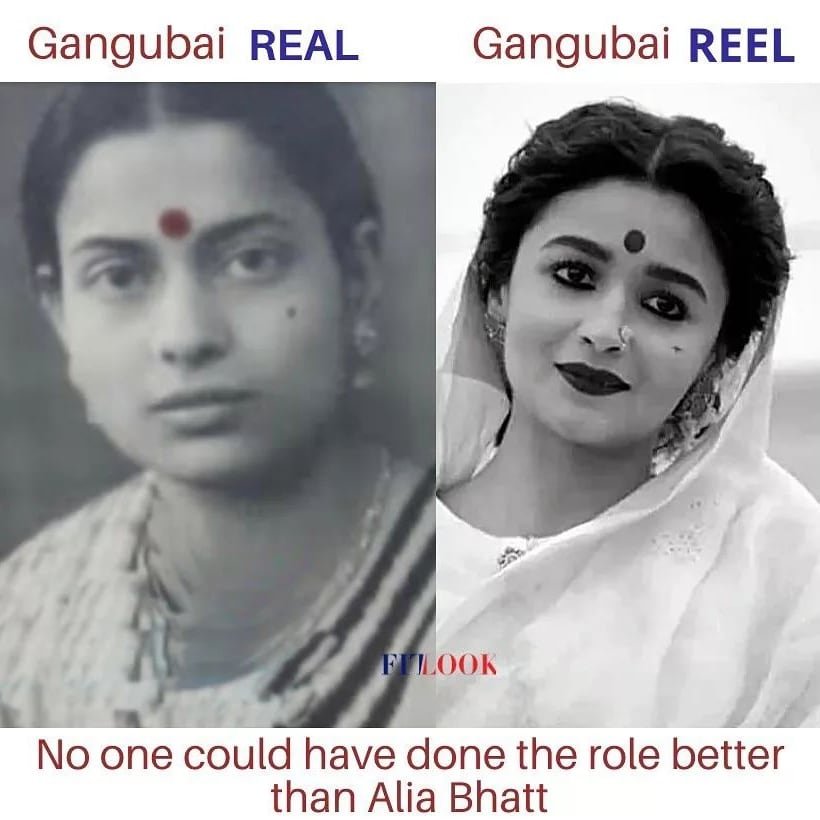
Gangubhai is a true story recorded in investigative journalist S Hussain Zaidi’s book, co-written with Jean Borges, titled The Mafia Queens of Mumbai. And as one would expect, it traces the journey of a 16-year-old minor, from Kathiawad, Gujarat, who elopes with her family accountant (who lures her to Bombay promising her a role in a Dev Anand film) but dumps her in Kamathipura, for the princely sum of Rs 500 (in the book…in the film it is Rs 1000).

Ganga becomes Gangu by her own volition, once she is violated and sees that this world has no real escape. Her respected family, filled with lawyers,  has other daughters to marry off…

What the book says is that once she adopts the life of a sex worker  Gangu actually becomes so good at her ‘job’ that she is the most in-demand prostitute in her brothel. There is, however, a devilish Pathan client whose horrific abuse – unchallenged by the Madam of the brothel for fear of the police – leads her to seek revenge…and that is the turning point of her hapless situation.

Gangu boldly goes where no prostitute ever has…meets Kareem Lala who heads the Pathan gang and shows him the terrible wounds inflicted by his henchman, that had her reduced to an invalid in a hospital, disfigured, broken physically and emotionally numb. She tells him how the animal left her uncompensated despite violent rape episodes. Kareem lowers his head seeing the cruel scarring of her fragile body and a platonic brother sister bond between this Lamington Road Don and the born-to-lead Gangu, powers her already spirited journey.

Right there we see an ever stronger young woman who can no longer be controlled by the Madam. And who seeks a life of some respect, recognition and even legitimate frameworks for sex workers condemned to be outcasts even though the most powerful Seths, power brokers and underworld dons frequent Kamathipura.

How this young woman travels in her first train ride from a respectable Kathiawad family to the urban Hades of Kamathipura, and then years later, boards another train from Kamathipura to the PM’s office, as an elected President of Kamathipura,  carrying within her a mission to find justice for the 4000 prostitutes under her charge …this is the brilliant trajectory of Gangubai.

But what makes this a highly resonant film? At the thespian level, Alia Bhatt. Many who have seen trailers of the film denounced a young Alia’s suitability for a role of a hardened, insouciant, warrior of a woman steeped in underworld ways of seeing and being.  What they don’t see is that Gangubhai’s own journey started at age 16 and she rose to power while still in her 20s, mid-20s…her triumphant years occurring in her early 30s. This makes Alia’s youth in consonance with the character.

Second, Sanjay Leela Bhansali is known to elicit pure magic from actors, throwing them into the Universe they need to inhabit, letting them become one with it. Ranveer had shared with me how he had isolated himself for a year from people, living in an apartment in Film City when getting into the evil psychology of Allaudin Khilji. So dark was that time for a man of Ranveer’s usual light disposition  that he even felt he saw Alaudin’s shadow once on the set! And even when we spoke of Allaudin the vanity van lights started to go on and off and the van started to shake, earthquake style …his immersion took over even our interview moments!

Alia who has led a fairly sheltered life as daughter to Mahesh Bhatt and Soni Razdan, has only ever tackled heavier and grimmer realities through the characters she has played. Remember Veera in Highway? Mary Jane in Udta Punjab?

Gangu’s pain IS her power. So much so, even when a chocolate boy (her tailor’s son) crushes on her, she plays with him as with a toy, not seeming capable of a vanilla love story any longer. The realist in her gets him to do the noble thing and marry a prostitute’s daughter…bringing for the first time a legitimate baarat through the infamous gallis of Kamathipura…and through her veil of unseen tears, we slowly understand that she truly has her family’s legal genes…she is a lawyer in her DNA…a justice seeker who will trample on her own happiness to improve the lot of women denounced by a world that buys their bodies and discards them.

The dialogues in certain scenes may well become iconic…the concluding lines if I remember them correctly…”Hassi unke kismat mein nahin..rona unke fitrat mein nahin..” (laughter was not in her fate and crying was not in her spirit)…and also her near poetic utterances to the Pradhan Mantri…urging him to legalise prostitution after he promises to Institute a committee to keep Kamathipura as their undisputed home…the richness of her last four insights when leaving the PM’s office, leave you wanting to run to Google translator to understand every nuanced meaning…!

Off camera, in many of her press interviews, one sees Alia explaining that her true strength as an actor is her ability to empathise with a character. In this role we do see how soft-faces can come with toughened eyes…and “the feminine power hidden in the folds of a saree can be deceiving,” as Hussain’s book tells us.

Alia’s character and Bhansali’s narrative are both augmented by talented screenplay writers… There is insight, humour, and a devil-may-care attitude in all the words she spews…her dimples firing their own missives. She is both Goddess and Superbitch, Victim and Victor, Venom and Antidote…in her dubious Queendom.

And it is all conveyed to us as energy.

Throughout the film, Gangubai’s eyes, often in extreme close-up, exude pain laced with power. When a character’s arc is so laden with a destroyed past, vulnerability, a forced and fallen identity, then an intense bid to survive and reinvent, to bury deep within, a betrayal of a first love for paltry profit, to then continue to sacrifice personal safety for justice… to build community and speak for voiceless and commoditised women.. through it all Alia’s eyes, body language and attitude, are in character.

One point Gangubai should have raised when giving a bhashan at a public political rally, when explaining how prostitution is the world’s oldest profession, and how male lust has spilled beyond the sexual cage of monogamy for centuries, often sparing their wives from perversions, abuse…if I was a screenplay writer, I would have also added that there are many levels of prostitution, which go unnoticed. Actresses sleeping around for opportunities..treated like goddesses once they succeed? Professionals in advertising sleeping around with producers for debuts as models or even to get directorial opportunities? Nobody condems that kind of transaction…but the Kamathipura prostitute is always spat on…though she is honest in her transactions. In Gangubai’s eyes, prostitutes are hafta-paying, rent-paying, police palm greasing, law abiding participants in the urban trellis of give and take….

On a parting note, I remember interviewing Soni Razdan, Alia’s mother, for VERVE magazine many years ago. Soni had a deep sense of regret for having married, as she felt a woman then makes her life all about good wifehood and often sacrifices and even buries the artiste within. “The film industry stopped approaching me as an actress, they worried about me being the powerful Mahesh Bhatt’s wife…saying who would dare ask her to act now?” Her generational dynamic still saw the movies as an exploitative industry, dictated by the Male Gaze. Not a clean place for wives of powerful men! After watching Alia as Gangubhai…forget the sold out First Day, First Show – I reckon mama Razdan must be thrilled to see her daughter taking her abandoned dreams to soul searing levels of excellence. While KJo may have exposed Alia’s blissfull ignorance of political figures, nobody can deny her mastery of character, dialogue delivery and command over the camera as an artiste.

It’s the Era of Heroines over Heros.

Would Ranbir ..the entitled and talented husband-to-be agree?

AHMEDABAD AHOY AND THE IDEA OF ‘META MAYA’!

FROM A DUSTY TEXTILE AND DYE MANUFACTURING TOWN TO A MALL AND BUSINESS HOTEL-FILLED CITY THAT SHOWS SOUL WHEN NURTURING ARTISTIC TALENT…AHMEDABAD’S PEOPLE, CUSINE, HERITAGE STRUCTURES AND STREET MARKETS (OPEN BEYOND 10PM) PROVE TO BE DELIGHTFUL, SAYS SANGEETA WADDHWANI

So many inhabitants of Mumbai and Delhi consider other metros to be in some way substandard when it comes to the quality of living. This myth is getting challenged each year. A recent trip to Ahmedabad offered a portrait of a city that once smelled of toxic textile dyes…(I remember a terrible attack of hay fever and an earthquake on my first visit in 1994)…now transformed into a commercial, ticking hub dotted with Novotel and YMCA International hotels, a mall of some scale virtually in every neighbourhood…and an art scene not driven by the commercial ethos and insularity that presides over Mumbai.

So very heartening!

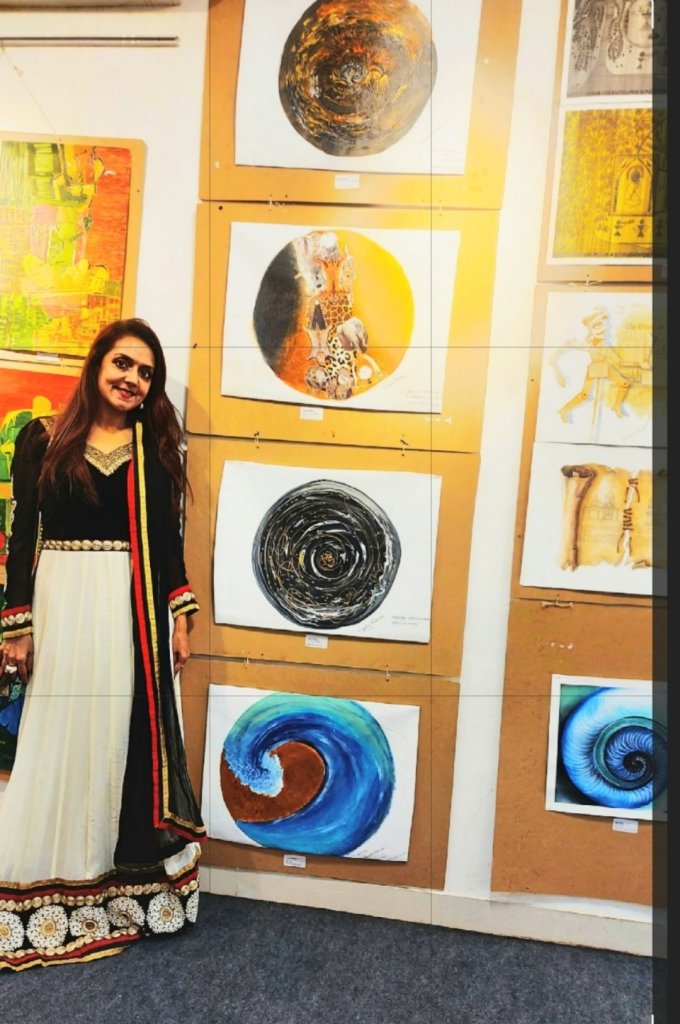
Hon Manahar Kapadia Ravindre Mardia and myself standing near my artworks…ORBITS OF REALITY
A sweeping view of energetic art at ICAC
A myriad styles of creating art were evident
The inaugural ceremony
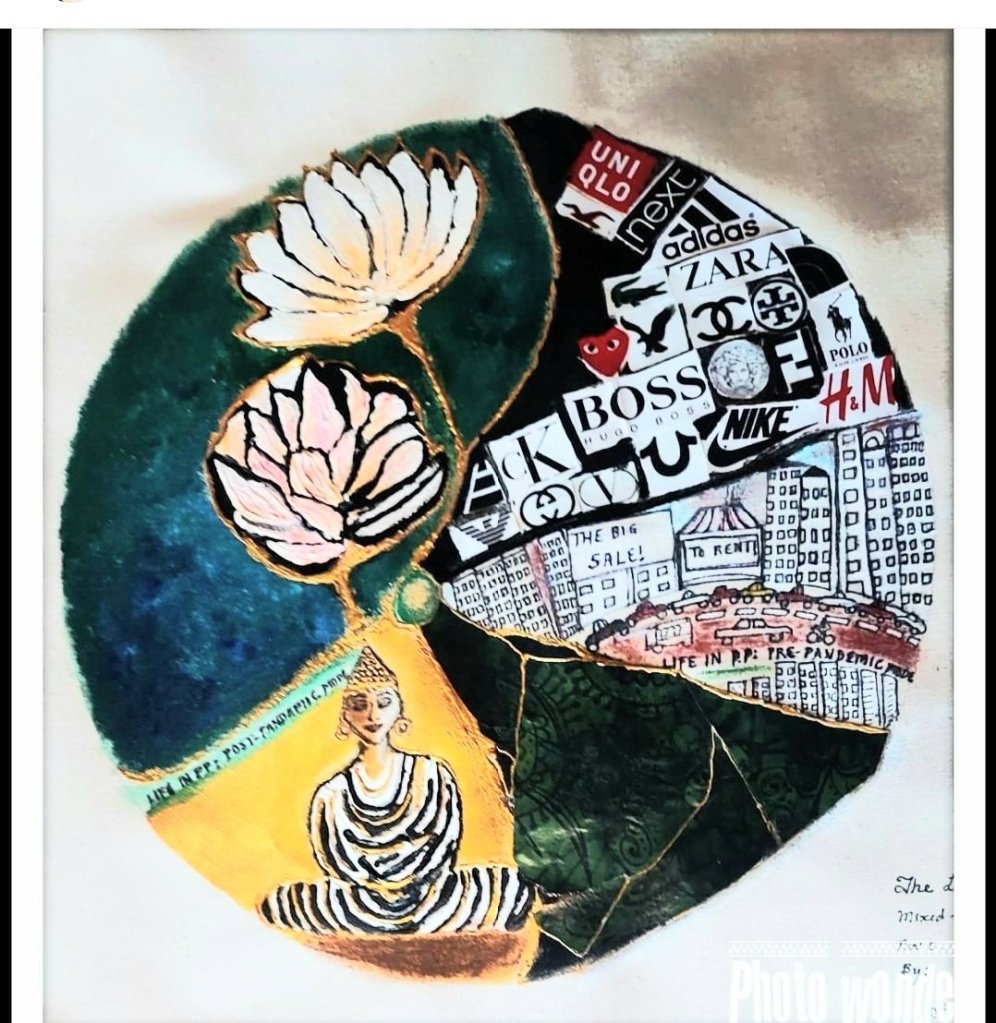
The LOTUS CONSCIOUSNESS, a work showing how subtly we have moved away from materialism to nature post- Pandemic

Yours truly was there to attend the third installment of a series of showcases of art entries for a nationwide competition and art exchange program hosted by the ICAC (Art Gallery. The man who conceived of this idea was Ravindre Mardia, President of ICAC, who couriered art paper and canvas (depending on the artist’s choice) to every participant. “We had 415 artists participating, and received a total of 1,684 artworks, from more than 100 cities from India & abroad,” shares Ravindre.

The diversity of styles, techniques used, and nouveau visual languages, was a treat to witness when we walked around ICAC on the opening of the third show for the competition.  Little wonder, when you consider that participants were not only from North, South, East and West India (from Gwalior to Guwahati, Jhansi to Junagadh, Kolkata to Kerala) but also slick global hotspots like Singapore, Dubai, the US, Bangladesh, Nepal, Sri Lanka, Spain and Hong Kong,”

Ravindra has a history of being in business as a manufacturer of metal goods, but has chosen post retirement, to nurture artistic talent in India. Just engaging with artists from such diverse geographic and cultural backgrounds in an age of online showcases and NFTs, is laudable. “Artists are often dealing with the pressures of full time jobs but with Pandemic disruptions and lockdowns, they were in a better place to create new art by hand, and hence we chose to have this contest,” he shares.

Ravindre and I had first met at the 10,000 square feet artspace called The Art Hub which he presided over, at the Atria Mall many years ago. Here, I was contemplating hosting my Coho Bohemia Bombay artwalk  as it was all about mixing a visual art experience with other art expressions..music, dance, poetry, prose presentations, theatre, short films, etc. I also secretly wished to showcase my Swarovski Divinity paintings there! Somehow this didn’t come to pass.

But here I was, many years later, part of Ravindre’s generous curation and vision in Ahmedabad…meeting his friend Hon Manahar Kapadia, IC Principal of the CN College of Fine Art, Ahmedabad, who opened the show. There was something pure and minimalist about the evening. Punctual. No wine (but nice cutting chai). No VIP marching in at a hefty price with an entourage, no paparazzi and no tamasha! Just reveling in art for arts sake.

Ravindre and I chatted about the decline of interest in art through the last two years, in Mumbai. One saw barely a trickle of art lovers attending show openings and “I see most people only visiting Jehangir Art Gallery for shows,” he shared. I ask him what he feels about the NFT-isation of art! And show him ‘iconic’ NFTS like the BoredApe, which has been traded like hot stock for millions, even when one sees no artistic value in the lame digital image. Even Warhol’s Campbell Soup on a loop made some kind of statement about American life!

Ravindre seems blissfully out of the NFT art “business’ so far though he shares, “Yes artists are wondering about earning well in this trade, but how many NFTs actually become so popular on the block chain?”

It reminds me of the many Indian artists of top stature who I had interviewed for L’OFFICIEL when digital art interfaces had become popular. MF Husain had felt that working with a mouse and digital palette and digital brush “did not feel painterly.” Suhas Awchat, Jaideep Mehrotra were just a few of this First Gen of artists expressing their ideas with digital interfaces.

Today one sees a parallel art scene that serves only a digital viewership where artists may never NEED to touch art materials or ever interact directly with galleries or buyers. Their ‘patrons’ simply click digital buttons and become token holders (joint stakeholders) of an NFT or pay a lot more and buy into its copyright! (We are talking upto 25 lakhs for copyright ownership!)

But where is the joy of carrying a physical work home…finding a place for it…gazing at it with different friends and family, across generations? Where is the spontaneous and messy experience of smearing colour and material around a work…clicking a mouse and dragging the cursor from a digital palette circle…to see what colours you are getting on a screen..it’s just way too clinical!

How do you feel about this digitization of art? At least at ICAC this dystopian form of art creation..or to be more with it NFT-isation and trading of digital imagery…seemed to be on the fringes of things. When Saraswati can manifest without the overt pursuit of Laxmi …it is said Laxmi gets jealous and starts to arrive at an artists doorstep!

Time will tell whether NFTS are just a bubble or will persist. Strange are the fallouts of the Great Digital Takeover of our world, Non Fungible Token did you say? But of course, fungus only collects on real time matter! Here’s to a non fungible formula for everything then…intelligence, relationships, ecosystems, societies community…for I believe there are people who live entirely in the Metaverse..inhabit cities there… drive, date people, transact, love and loose..

We in India had a word for it centuries ago…MAYA. Meta Maya? Sounds like a deal embraced by a crazy new world!

Sangeeta wears a skirt found in the Law Garden market at the spectacular Adalaj Stepwell

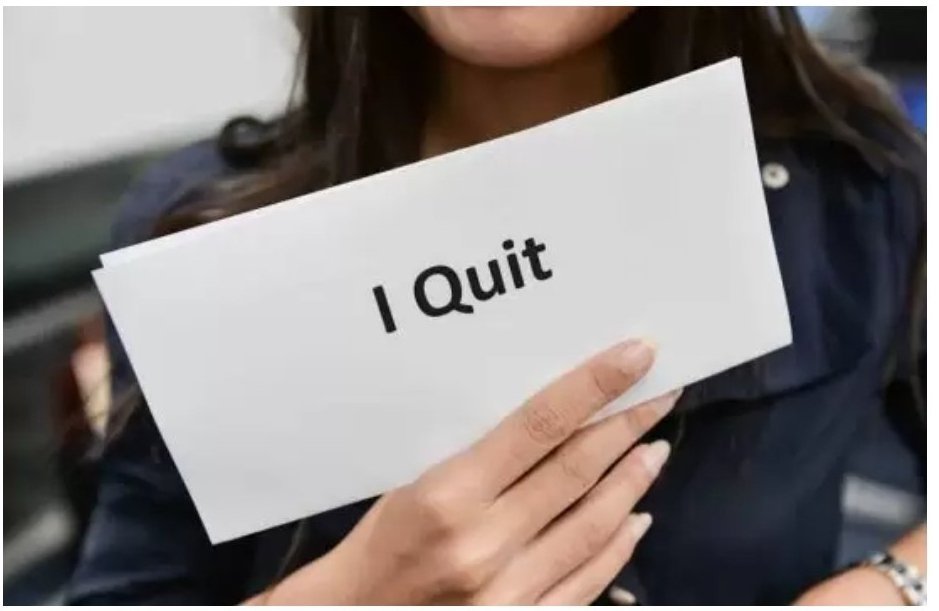
“WE QUIT!” THE GREAT RESIGNATION DECODED

SANGEETA WADDHWANI EXPLORES WHY SMALL AND MEDIUM ENTERPRISES – EVEN TRADITIONAL CORPORATIONS – ARE BEING ASKED TO EVOLVE, REVIEW THEIR ATTITUDES AND STRUCTURES… OR RUN AN EMPTY SHIP!

The Great Resignation.

The destabilisation of evil bosses.

No More Squid Game… Game Over!

Step into your CEO’s shoes, and Imagine how it would feel to walk into your company headquarters, to find computers blinking blankly at you, plonked on abandoned desks, with bewildered peons wondering when the Old Normal will return. Little guessing that what has happened is subtler than a paycheck… truly other-worldly. And irreversible.

‘According to the US Labour Department, around 4.5 million employees left their jobs in November 2021, a trend observed since September 2021 with 3 per cent of the workforce quitting their jobs each month. This amassed a record 75.5 million resignations in 2021 in America alone, and the trend is expected to continue into 2022. Furthermore, 23 per cent of the workforce expressed a desire to switch to new companies in 2022.’ (Source:jagranjosh.com)

Says Michael Karp, a Canada-based creative professional who is American, “Notice that the US COVID relief checks to individuals cost half a trillion dollars. But the US government didn’t actually have the money. So they printed it. So one of the major causes of the Great Resignation was the stimulus checks, which paid people to “resign”. And since the stimulus checks were fake money, that caused the highest USA inflation in 40 years.”

The ‘Great Resignation’ was further augmented when the American administration refused to provide employee benefits in response to the COVID-19 pandemic. The movement was also fuelled by a new awareness of subtle burnout, a switch from 9-5 office grids to an unprecedented work-from-home culture, and for many, an opportunity to review what could be a more suitable profession, and a fresh review of long term goals. Amid the Great Resignation, a strike wave known as Striketober began, which many economists describe as the employees participating in a general strike against poor working conditions and low wages.’

THE GREAT RESIGNATION? OR THE GREAT RENEGOTIATION?

THE PICTURE IN INDIA

In a country as populous as ours, skilled workers have been, more often than not, taken for granted. While the sprouting of start-ups with a digital spin grew by leaps during the Pandemic, when one chatted with employees, one found that salaries were conservative, far below what market rates were. In some start-ups, employees were expected to be ‘okay’ if paid upto 20 days late. In others, they were expected to work 13-hour weekdays, with no recourse to a gym, no family-time factored in… with an overseer who may even take sadistic pleasure in not letting an employee leave work at 7.30pm on a Saturday!


Now imagine this new ‘sab-exploit karo’ culture of the Great Indian Start-Up movement, confronting a workforce that had been finding new ways of living after L&L hit them – Lay offs and Lockdowns. These talented and skilled people had started embracing their homes and hearths with a new viguour. Many were Pandemic Reborns, released corporate ‘prisoners’ from their hazardous-to-health work routines (remember ‘sitting is the new smoking’). No more doing the sitting-duck- for-lifestyle-diseases routine, no more doing the hum angrezo ke zamaane ke jailor hai eight hours, Monday to Friday (but at least that meant free weekends, unlike with the start-ups). The Pandemic showed us that we were as creative and efficient without the ‘baby-sitting’ protocols of office timings, and capable of multi-tasking across domestic and work responsibilities.


In the first year of serial lockdowns, I found myself a turbo-charged, pro-evolutionary machine, refurbishing my kitchen – something I couldn’t do for 13 odd years working the sacred Fixed Hours. Yes, I missed my colleagues and the on-call help from the IT guys, but I had devoted enough time to the business of ‘business’ and now wanted to float in a parallel universe of independent writing, video blogging, and jumping on the proliferation of courses available online, reskilling furiously for a Brave New World where profit had suddenly abandoned my beloved print media.

YOU MUST ADJUST!

To quote Emmy award-nominee Seema Taparia’s viral wisdom, ‘YOU HAVE TO ADJUST.’

Sure there was wallet culture shock. One felt diminished not running around doing impulse purchases, taking endless uber rides to events, or booking flights to anywhere for any reason… but frankly, those elaborate wardrobes and hectic lifestyles were out of synch with the Universal agenda. The Universe wanted us to stop leaning on consumerism and fossil fuel consumption which was slowly killing us by health issues caused in turn, by a dying planetary ecosystem.

I can swear on all my Dolce & Gabbanas, McQueens and Michael Kors purchases, which had hardly been touched in two years, that this New Religion had me as a convert. I found a New Abundance came along with the conversion… the freedom to use my time as I wished. My tarot cards helped me appreciate this – I repeatedly saw the card for ABUNDANCE show up, and when I read the meaning, it indicated that with the kind of time I had, a whole portal of new possibilities lay in front of me. Never had online learning hit such high notes – one could sing along with Asha Bhosle, pick the bleached bones of storytelling from Salman Rushdie or learn how to write a Netflix webseries with Shonda Raim (Masterclasses), or learn screenwriting from our very own Boman Irani. Post the first major lockdown of 2020, I uploaded my first e-book on the conundrum of dating in young India, called MIND THE GAP! Which hit the sweet spot… No 1 in its category on Amazon, within four days. Almost immediately I could see it as a webseries on Netflix!

After tasting such an eclectic menu, a routine job with its politics and pressures, its limited and fixed use of one’s abilities, feels like a return to the era of black and white cinema. Our skilled work force has now learned to deliver on deadline while waking up to endangered birds chirping, the aroma of lemongrass tea mixed with grass laced in morning dew, many sitting in rented homes in Goa, Alibag or even all the way up in Rishikesh. They are able to squeeze in time for morning yoga, time to sit with the kids for homework and of course, Zoom-dabaad when one wants to meet, talk to or teach the world when necessary.

While there are no statistics to support this, the media grapevine had it that many young people working in traditional media organisations decamped and started independent careers as social media managers, or digital marketing pros. For them, going back to a single-channel life, aka a regimented life in an office in a concrete jungle, would be like going back in time and watching Doordarshan, where the signature shehnai ‘logo’ tune warned of centrally powered broadcasts encased in superb predictability.  Boss-log, wake up and smell the matcha – the human spirit has been taught to dream and fly again… and the attrition rate in many industries is proof of this Pandemic pudding.

—————————————————–

‘Boss-log, wake up and smell the matcha – the human spirit has been taught to dream and fly again… and the attrition rate in many industries is proof of this Pandemic pudding’

SANGEETA WADDHWANI

—————————————————-

‘People now value the flexibility to work from home as much as they would a 10% salary hike. As a result, companies are now offering flexible work weeks with many shifting permanently to work from home’

– PLANET MONEY

—————————————————

‘It’s time for organisations to wake up and smell the coffee because their people are! One of my favourite quotes on leadership is attributed to Alexander the Great “ There go my people, and I will follow because I am their Leader”’

–   MIMI RAO 

—————————————————-

It hardly came as a surprise when I saw a newsletter from Planet Money, authored by Greg Roselsky, titled, The Great Resignation? Looks More Like the Great Renegotiation!  We read in this, that “Americans are not en masse rejecting consumerism, moving off the grid, and living off the land. Most still need money. Some of those quitting are older workers deciding to retire early in large part because their finances have been buoyed by surging stock and housing markets. Others are secondary earners who have stayed home because they have had to take care of kids while schools have closed due to COVID-19 — or because, more simply, working face-to-face during a pandemic sucks.”

I had a chance to get live inputs from friends either walking away from the 9-5 or pandering to people walking away from it. My friend Mimi Rao, Associate Director for Technology with Ernst & Young, has recently transited from the UK to India and is contemplating an early retirement, and she refers to this mass shift also as ‘The Burnout Pandemic’.  Says she, “One of my favourite quotes on leadership is attributed to Alexander the Great. “There go my people, and I will follow because I am their Leader.”

Among the many ‘whys’ of The Great Resignation she concludes that the real elephant in the room, is the work-life balance. “Human beings are programmed to believe that death is something that happens to others, and we are eternal, yes there is death somewhere in the distant future but it’s not a real concept in our lives, so time too feels unlimited. The pandemic brought about a paradigm shift; everyone knows someone who has lost a loved one. Time has become limited and precious. We are no longer a society that wants to miss a parent teacher meeting for a work meeting. A zero less in the bank balance is happily traded for a child’s soccer game. This is also a great correction, a realigning of priorities.”

Of course, the legitimate question would be, so, what’s paying the bills? “Well people are not idling, they are working better and smarter and technology has been the great equaliser in the game! The number of new start-ups where people have turned hobbies into work are booming, trading in currencies is no longer the prerogative of traders in ivory towers, it’s accessible to millions on their smart phones! The gig economy is here to stay, work hard for some time and play hard after to rejuvenate! Part time remote working from beaches and mountain tops is spreading faster than the pandemic.”

She believes that organisations which respond to this shift will sustain a happy and healthy workforce. This, and any set up supportive of a sustainable planet, “will be the final winners in this game. It’s not the corporate jungle anymore, it’s the serene calm of the ocean we seek.”

Kiran Addala, the India Business Head of JBrown, (www.jbrown.com) a London-headquartered real estate consultancy with a global presence, has seen the property enquires for Alibag and Khandala/Lonavala and Coorg in South India, sky rocket post-Pandemic, which mirrors the quest for a more soulful life. “We see a significant increase in demand for land and properties, with better access thanks to the Ro Ro service, and smaller boats also plying there. It’s a fantastic weekend getaway. We have seen a significant increase in property and land prices, as well. So for example, we had a property sold a few years ago, which has now tripled in value, and still has takers! This is a great indicator. There is a scarcity of land in the prime areas of Alibag, because it has been a prominent holiday spot for high networth individuals, celebrities, and industrialists for some years. But now there is an even greater hunger to be by the sea, to relish fresh air and open spaces and beautiful views even from the hills. It is going to be the Goa of the West Coast of India… and a highly convenient weekend escape.”

He has also seen a demand for having Vaastu consultants involved, even before the paper work is done! He also sees world class architecture finding its place in this offshore paradise, with new design narratives coming into play.

“More recently, a helicopter company wants to purchase land for a helipad, based on research looking at the traffic between Mumbai and Alibag!” he shares.

Clearly, the M2M Ferries Ro Ro (Roll-On-Roll-Off service for private cars, saving 111 km of driving) is a mega-post Pandemic success story. The social ‘scene’ onboard the Ro-Ro open-air decks competes with the best of social institutions like city clubs and popular events – yours truly was witness to this last weekend itself!

All indications point to a ‘Back to Nature’ quest… trust me, you are freed of the stress hormone cortisol, responsible for perhaps making India the diabetic capital of the world…just the smell of rich and fecund soil around your swimming pool as you come up for air, just the feel of early morning sun on your Vitamin-D hungry skin, and the nerve-soothing sand under your feet as you stroll at sunset on a beach… your mind-body system thanks you for FINALLY ‘getting’ life. It’s all about nurturing the present moment… with friends, family and plenty of nature….

The Great Resignation is leading the way….

Papayas growing in the garden around the holiday home near Alibag
The author sitting
by a swimming pool at sunset in Nandgaon, near Alibag
Daily sunset walks with friends
Chilling with actress and yoga exponent
Soma Mangnani
The author braves an early morning swim in water holding freezing night temperatures…a great boost to the metabolism!

THE GREAT RESIGNATION

THE SURROGACY SOLUTION: WILL RICH & FAMOUS WOMEN WALK AWAY FROM BECOMING PREGNANT?

FOR WOMEN WHOSE FACES AND BODIES ARE THEIR FORTUNE, SURROGACY HELPS THEM GROW FAMILIES WITHOUT STRETCHMARKS, MATERNITY LEAVE, DOUBLE CHINS, VARICOSE VEINS AND UNGAINLY SILHOUETTES. SANGEETA WADDHWANI CALLS OUT A HISTORIC SHIFT WHERE GLAMOROUS WOMEN ARE CHOOSING NURTURE OVER NATURE

The Duchess of Cambridge popped out three royal munchkins without skipping a beat. She had nary a baby bump to worry about, and faced the 24/7 paparazzi looking immaculate in her Buckingham Palace-approved blue chip wardrobe.

Here in India, an as-much-under-media scrutiny Aishwarya Rai Bachchan swelled up half a decade or so after marriage, both with pride and pregnancy poundage, subjecting herself to the age old female script of career, marriage, babies where the latter often takes precedence over every other consideration. Till the pregnancy happened, the ruthless and tasteless desi yellow media went on about her having TB of the uterus, and other idle and evil speculation. It was a bizarre trial by media, as if an actress’ life MUST pan out in a filmi sequence. It never occurred to the largely female newspaper snipers that an actress may choose to NEVER expose her delicate contours to the riotous disruption of a pregnancy. Because Ash was a good middle class girl from suburban Khar, she put herself through the nine yards (read months) of identity sabotage and bore Aaradhya like a badge of honour. Remember how photographers delighted in capturing a much fuller Ash with an almost vanished waistline on the red carpet at Cannes?

A director who cast her in an archetypal role as the Paro of Devdas, even went on record to say “Beautiful women should never become pregnant.”

As is custom in showbiz there were whispers and murmers all over about this fuller version of iconic grace, having lost her IT factor to motherhood.

Now let’s be honest. There definitely is a lot to be said for the price Nature elicits from women of beauty becoming fecund and real, their bodies like rivers in spate, waiting for the harvest of a ripened fetus.

Ash took a five year sabbatical from the headless marionette routine of fittings, rehearsals, light, camera, action, film promotion, and so on. She didn’t think work, wealth, pulchritude and performance in reel life were the only things that mattered.

It was the same with Shilpa Shetty, who put herself through the whole sacrificial spectrum of pregnancy when carrying her first born. Viaan. She had shared with me for a special exclusive cover story, that her muscle tone got so poor and her weight at 80 plus kgs was so daunting..she had trouble squatting and picking up her toddler! So hit the gym she did with a vengeance. But baby no two was a breeze…because another womb manufactured that bun! In Shilpa’s case, she at least tried to put a story to the choice of surrogacy…she had an autoimmune condition that led to several miscarriages. Fair enough. Because surrogacy was a 21st century invention, a new privilege extended to those who could afford delegating pregnancies.

This is where we sit on the edge of an age old value system that demanded pregnancy of a married woman. It was divinely ordained that she offered the gift of new life and family to her spouse.

In centuries past, our elders did not envisage a world where female ambition would pretty much play out on the scale it has. To me, an accurate symbol of this shift, is the bi-continental supernova, Priyanka Chopra Jonas. Everything about her journey takes the tired Feminist debate to exciting questions. Should a woman marry a man a decade younger? Of another culture and nationality? Should a woman dare to be rich and famous across two continents? And my word .. Should she ‘delegate’ pregnancy to a surrogate, so she doesn’t skip a beat in her highly visible line of work? More so because at 38, when she has iconic franchises like the Matrix Ressurections and solo lead roles in Hollywood knocking..this would be a ridiculous time to get inflated, semi-retired and sentimental about growing a fetus in the fashiontastic premium real estate of her body?

Think about it. Yes of course serious commentators on the chilling exploitation of less privileged women becoming fatally ill due to a serial hiring of their wombs, have to be listened to. Authors like Pinky Virani and her book, The Politics of the Womb, raise critical issues on the subject. Legal frameworks and regulation are needed to ensure that surrogacy treats both, the Yashoda and the Devaki, (the nurture mother and the natural mother) fairly.

And one would love to hear what the feminists are thinking, as surrogacy takes consumerism to a new edge. A friend of mine, the singer and yoga exponent, Shweta Shetty, expressed how she felt about how this great new facilitator of motherhood for women in high visibility areas of work. ” I feel the bond built between the fetus and the mother is irreplaceable and cannot be experienced through surrogacy.”

We will be hearing from more women as this blog makes the rounds. What is your take?

THE SURROGACY SOLUTION

IS GENDER A FUNCTION OF THE SOUL, OR THE BODY?

Lord Shiva wears a Nath and a saree to witness the Raas Lila!

MAINSTREAM CINEMA HAS ONLY EVER FEATURED LGBTQIA+ PERSONALITIES AS CARICATURES. CHANDIGARH… WAS THE FIRST ATTEMPT TO ZERO IN ON A TRANSGENDER HEROINE. SANGEETA WADDHWANI TALKS TO CINEMATOGRAPHER MANOJ LOBO ON THE NUANCED FILM OUTLAY TO MAKE THIS A ‘PALATABLE’ EXCURSION, AND ALSO OFFERS PERSPECTIVES FROM INDIAN MYTHOLOGY ON GENDER FLUIDITY

Through study (acquiring self-knowledge), we bridge the gap between the conscious and unconscious, the soul and ego, and the masculine and feminine.”

India’s core spiritual culture has always urged humanity to transcend dualities. So yes, while somewhere down the line, North India went the patriarchal way, and South India still held a matriarchal sway, the modern world has truly seen a flatter world between the binary of man and woman, where both are competing for the same opportunities, both operate in an information age and tech-based world, and the odds of success, truly favour grey cells over any other body part.

In the film, Chandigarh Kare Aashiqui, Vaani Kapoor’s character, Maanvi Brar, is a transgender girl. She becomes the love interest of a small-town school product, Manvinder Munjal, played by a pumped up munda, Ayushman Khurrana. She is a Zumba instructor, he is vying for a title as a heavy weight champion. The polarity is potentially perfect: An alpha-male and a hot young woman, both gym-perfect, leading independent lives. But then… they get involved… all is well between them till he pops The Question. She tells him about her sex-change journey, all hell breaks loose. The perfect couple find cracks and gaps that he, more than she, can’t bridge in his psyche.

“It’s interesting how easily a story like this could have put off a mainstream cinema audience,” I say to Manoj Lobo, the cinematographer, who admits that it was a tight-rope walk.  

“When translating words to screen, we kept it light and bright in our visual treatment. We didn’t do primary colours, we didn’t do deep shadows. To me, the fact that Maanvi was a beautiful woman, was important. The colours in the film are alive, they are happy, they pop. It is not a dark story. It is every bit a romance but with a twist.”

However, I tell Manoj, I had a little trouble ‘believing’ in Maanvi. Why? Because I had known a transgender living in my building. She was part of the jet-set elite, and that meant she had a lot of money at her disposal to ‘fix’ her body in ways that assured her of her female identity. Yet in the elevator, in her body-con dresses with plunging necklines, she would lean over and ask me, “Honey, do I look like a real woman to you?” (In fact in the end, rumour had it she died of heartbreak and excessive fiddling around with surgeries and hormones, at a rave in Goa!)

In this film, Maanvi was constantly and consistently ‘prettified’ and any hints of her identity being insecure, very subtle. “There is this scene where she is walking in the park, and hears laughter behind her. She is not sure if they are laughing at her, so she removes make-up from her bag and touches up her face,” points out Manoj, while admitting it was subtle.  

Other than the insecurities she expresses to her butch-bestie, about her fear of getting ‘dumped’ by Manvinder, because relaying the truth about her gender journey to her boyfriends always resulted in ‘the end’ for her, Maanvi otherwise, seems like any other independent migrant professional settling into a new job, away from home. No hormone pills for her. No voice breaks. No ‘practicing’ a feminine walk with books on her head. No sashaying in heels with exaggerated feminine accroutements like XL eyelashes or glitter eye shadow.

“Yes, we did meet a host of transgendered individuals, spanning all walks of society – even the ones for whom investing in the transition wasn’t that easy – but more important, we even met their partners. Because an important question was, whose story were we going to focus on? Gattu (Abhishek Kapoor) the Director was quite clear that it has to be the man’s story… a man who understands and accepts this person,” admits scriptwriter Supratik Sen. “Well ok, ‘accept’ is a big word, but at least understanding a transgender girl, is also a huge shift. And we were sure Maanvi’s character would be strong; no ‘come to my rescue’ or ‘damsel in distress’ kind of thing. The idea was for the man to step up and take the plunge. The onus was on him, to grow, evolve.”

It was a happy if uneasy ending… with a lot of unanswered questions that one would imagine a ‘hero’ seeking normality would ask…. Like how about children? Would Manvinder go to a surrogate for a family?

But let Bollywood do what it does best – tease its audience with gentle provocation. It is after all, a mass medium and the masses “respond to art and beauty far more readily than just information. So we used that route to primarily sensitize people to the trans-community. There is a lot of misinformation, a lot of phobia. Art and beauty open people’s hearts and creates empathy where otherwise there would be none,” as Manoj explains.

It is ironic that cinema is taking India back to her own highly inclusive, gender-flexible culture. In Indian myth, as mythologist Devdutt Pattnaik has often shared with audiences at various lit fests, there is room for every kind of being between the male and female polarity.

“Read the Tulsi Ramayana, from 500 years ago. He talks about how God allows all creatures inside Him: ‘Chara, char (plants, animals), Nar, Napunsak, Nari (so Man, Queer and Woman). The literal translation of Na-Pun-Sak is, ‘Not Quite A Man.’”

One doesn’t see such individuals mentioned in Abrahamic faiths (Judaism, Islam, Christianity), or Greek myth. “In Greece, one sees Man-boy love, but not a Third gender. In Greek lore, you do see powerful women not associated with men at all… like Goddess Athena, who has no male consort or lover. However, Hinduism alone had a term like Napunsak, a word for a Third Gender; it is a philosophy that speaks of diversity, obsessively.”

Years ago, I recall hearing Lakshmi Narayan Tripathi, a celebrated transgender speaker, choreographer, artiste and an activist, speaking at a public platform at the US Consulate in Mumbai, about how ancient India had very clearly defined roles for the transgendered. She talked of how they guarded the women’s quarters in palaces (zenanas), they entertained (some renowned Lucknowi courtesans were transgenderered), and they went about with their ‘maang ti’ or asking for alms in exchange for blessings metted out to newborn babies, or other major auspicious occasions. They were respected and had a clearly defined social role with income streams.

A lot of their relevance is lost in a modern nation.

This is a direct consequence, in many cases, of India’s invaders. “While the Mughals brought the word ‘hijra’ – the root word was ‘haj’ and conveyed a journey, the Mughals still had a place for the transgendered in their palaces. However, the British criminalised love between transgenders and homosexuals, throwing them outside the frameworks of ‘legal and respectable’ society, with Article 377.  India only negated that two-century old legal framework, in 2018. The gay, bisexual, lesbian population may have had to go underground, but the highly divergent ‘hijras’ were reduced to beggary. They were marginalized at every level – mental, emotional, physical, economic, social.

However, the Third Gender community has plenty of support from deep within India’s literatures – spiritual sagas that show gender-fluidity to be the path walked by all… from the Hindu Trinity to the demigods and goddesses.

“Go to Vrindavana, in Uttar Pradesh, and you will come across the Gopeshwara Temple, where Lord Shiva’s face, carved in the shape of a Shiva Linga, wears a Nath. Legend goes that the alpha-male Shiva wanted to witness Lord Krishna’s Raas Lila, but the Yamuna river did not permit him entry, telling Him only women were allowed to dance with the Lord. So Shiva transformed into a gopika,” mythologist, historian Devdutt Pattanaik had shared at a Queer Lit Fest in 2017.  

Devdutt also shared the story of another God, Aruna, the God of Twilight, who becomes a woman as he wants to see the apsaras dance. Lord Indra falls for Aruna’s female form, has a child with her, who becomes Bali. She also has a son with Surya, called Sugreeva. “Both are sons of an ‘assumed’ woman, who was initially a man!” we are reminded.

Lord Vishnu becomes Mohini to ensure the Devas get all the nectar

One of my favourite stories showing gender-fluidity by Lord Vishnu, was that of  the churning of the Ocean of Milk. With the devas positioned on one side, and the asuras on the other, the idea was to churn the Ocean of Milk till a jar of nectar bestowing immortality, arose. This was of course an extensive process: Mount Mandara was used as the churning rod and Vasuki, a Nagaraja who abides on Shiva’s neck, became the churning rope. Before the Samudra Manthana process could release the nectar, it released a number of things. One of them was the lethal poison known as Halahala. Towards the end of the churning, the devas fear that the asuras might take the pot of nectar first and finish all its contents before they get a chance to drink. So lo.. Lord Vishnu finds the perfect solution. He takes the form of a beautiful woman, Mohini, who enchants the Asuras so they don’t dare question her when she first serves nectar to the devas. By the time she finishes pouring the golden fluid into the last deva’s glasses, there is none left for them!

These stories – and many more – reveal that in Hindu lore, bodies are fluid. Gender identities are fluid. Lord Krishna is Himself an embodiment of both masculine bravery and feminine lasya; we can see him buying silks, wearing kaajal, playing the flute, contemplating nature, enjoying sandalwood body pastes – if we saw a man today with such a harmonious blend of both, warrior and musician, dancer and strategist, what would we think or say?

Let’s think of the Tribhanga pose. It is a feminine, curved stance, that Lord Krishna adopts, when playing the flute. It implies that flexibility is feminine, grace is feminine.

‘Gender is a mind-thing. Gender can be bent. Souls goof up when choosing which gender to be born in. Let’s give dignity back to those standing between binaries’

SANGEETA WADDHWANI

This resonates with a wonderful exposition by Manoj Lobo, about the film being a “curved story in a straight city. Chandigarh is built like a wire mesh. It is a grid.” In many ways, the mentality left by the British, too, was a mesh. But Lobo’s recent experiences show that the kinnars have not all lost touch with ancient systems known to their community. He recently spent two days filming 35 prominent kinnars, who came from north-south-east-west India, to a conference in a hotel in Delhi. “The idea was for them to come up with a Vision and Mission Statement, and even a Tagline. These are ways the community can build a modern identity and be immediately understood, like how you have Amul, synonymous with The Taste of India. It takes a lot of conversations and insights to come up with these statements and taglines… and I was filming all of that!”

Manoj goes on to reveal how vibrant the community is. “Some are doing social work through NGOs in Jaipur, others are even rescuing victims of natural disasters, like victims in Odisha. To this day, they have their own guru-chela system, their own gharanas, (yes, like classical music schools), even their own Akhaada during the Kumbh. There are 12 Akhaadas, all belonging to males, none for women… but one Akhaada solely for kinnars!”

As I move away from this blog, I remember how utterly hilarious gender fluidity has been in classical films like Hollywood’s Mrs Doubtfire, (and India’s saucy take with Kamal Hassan in the lead, Chikni Chaachi!) As Tantric lore says, we are all a combination of Shiv-and-Shakti. And in fact, one of Sadhguru’s books taught me that more dominating souls tend to choose a woman’s body, while more passive souls choose a male body.

At the end of Chandigarh Kare Aashiqui, we see a strong, dignified female spirit in Maanvi, who gamely reminds her lover that “I didn’t reject you, you rejected me.” However, to give Gattu credit, the character really doesn’t want sympathy. She just wants to Be.

It is only in asides that we see Maanvi’s inner struggles when she talks to her father… who feels, how long can this boy-turned-girl battle this world, how long can she be by herself, was she not exhausted always standing alone?

Fortunately, the movie offers hope…. We do not know how many transgendered girls find such silver linings, but the movie gifts a different perspective to mainstream India.

Gender is a mind-thing. Gender can be bent. Souls can goof up when choosing a gender to be born in. And then, some choose to walk the earth representing Shiv-Shakti in one body. Like Puttaparthi Sai Baba did. Let’s acknowledge our inclusive culture, inclusive stories, inclusive avataars, and give dignity back to those standing between binaries.

CAITLYN JENNER WAS BORN WILLIAM BRUCE JENNER IN 1949.